
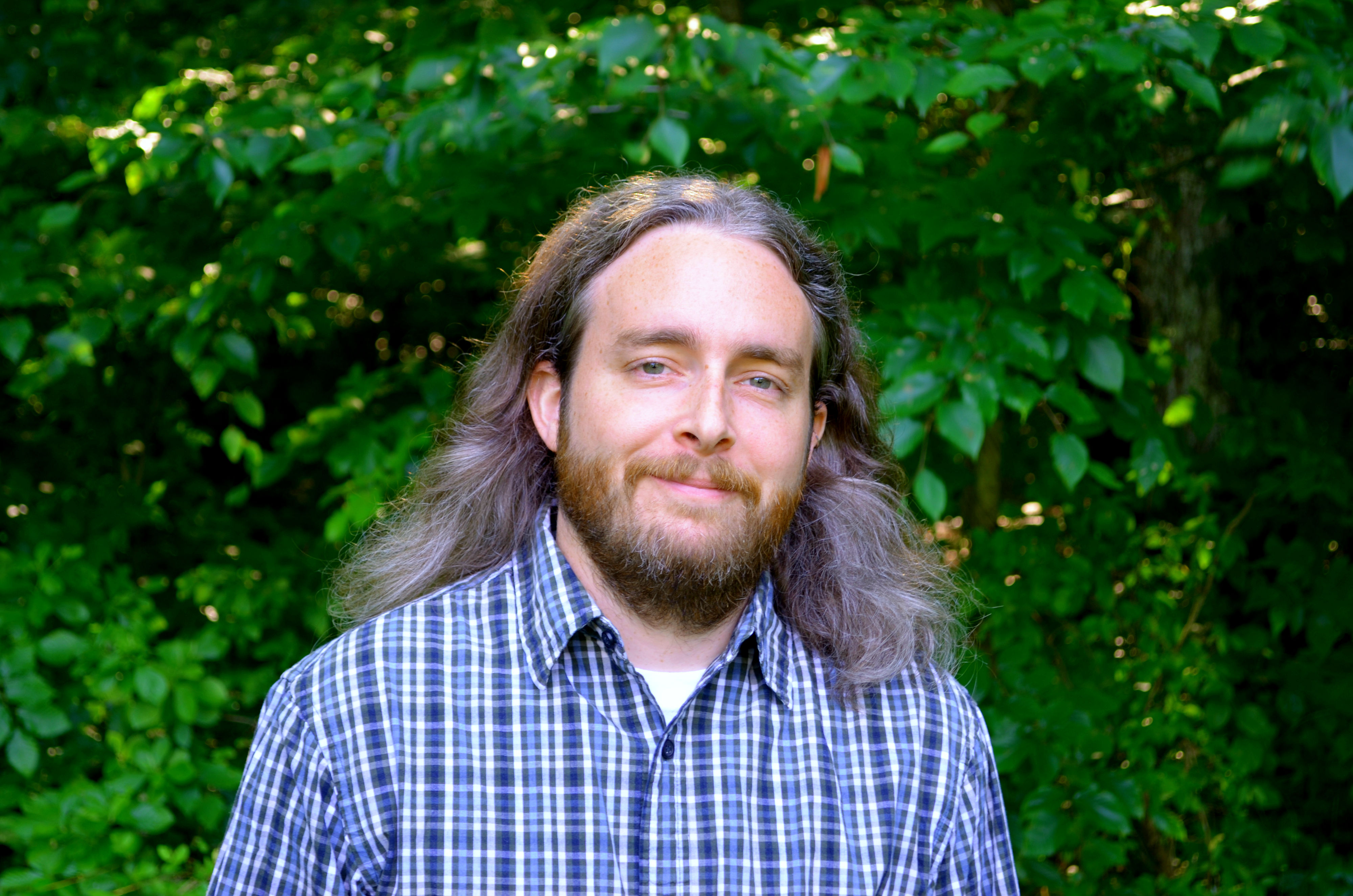
I’ve always desired to write ekphrastic poetry that brings a piece of art even more to life than it had originally been. It’s a way to honor artwork with words on the page. Ekphrastic poems such as William Carlos Williams’ “Landscape with the Fall of Icarus” and Anne Sexton’s “The Starry Night,” both based on paintings, fed into that desire to write something of my own. that I didn’t know if I ever could. I’ve also always been one to look for the beauty in everything: people, animals, literature, art, disaster. Adam Tavel’s Rubble Square helps me find that beauty. Tavel’s most recent collection takes us through time and space and back again. It is for the thinker, the researcher, the artist, and the art itself. As a previous contributor to Pine Hills Review, we’ve had the honor of reading Adam Tavel’s work, including “Selected Poems,” which you can find on our website as well as Rubble Square.
Adam Tavel is the author of multiple books including, Rubble Square (Stephen F. Austin University Press, 2022), Green Regalia (Stephen F. Austin University Press, 2022), Sum Ledger (Measure Press, 2022), 2017 winner of the Richard Wilbur Book Award, Catafalque (University of Evansville Press, 2018), The Fawn Abyss (Salmon Poetry, 2017), and Plash & Levitation (University of Alaska Press, 2015), which won the Permafrost Book Prize in Poetry. His work has appeared in Diode, Verse Daily, The Georgia Review, Puerto del Sol, New Ohio Review, Sixth Finch, Salamander, Potomac Review, and American Literary Review, among others. In this interview, we discuss Tavel’s inspiration for writing ekphrastic poetry, reviving art through literature, and how this interview will be his last for “a very long time.”
As a writer traveling through the confines of space and time through artwork and writing, where do you imagine answering these questions? A specific art piece, a specific place in a particular time? Where do you find yourself physically?
I find myself at midlife in America in May 2023 as the world burns, as our democracy teeters on kakistocracy, and as summer looms, another hazy promise. I write to you from my scrunched and dusty home office—a tiny spare room with a Goodwill desk—surrounded by bills and books and guitars. I also find myself, after much reflection this past year, no longer a public poet, having dismantled my personal website, deleted my social media accounts, and declined invitations to read as a means of protecting my neurodivergence and rejecting the slick literary commercialism that I hitherto rationalized and participated in for the past twenty years. Like many, I went in search of fellowship but merely found another cloying marketplace. Apart from my poems themselves, this interview will be my last public statement for a very long time.
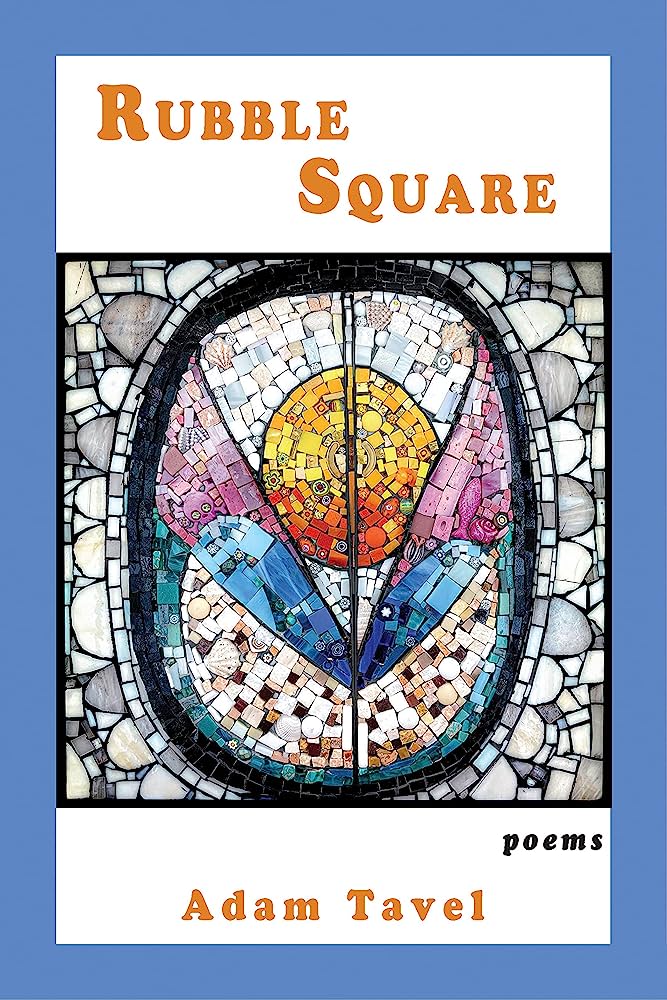
It is an honor to be the person to have conducted your last public statement for a while! One of the first things that I want to ask about is the cover. A stained glass work that can be seen as either a flower, the sun, a ball of light, or a limited landscape view. What is this piece of art? What do you see when you look at it? Why was this piece chosen as the cover of this poetry collection?
The cover art for Rubble Square is a mosaic by my friend and long-time collaborator, Madara Mason, who has, much to my perpetual amazement and delight, provided the cover art for all six of my books. She’s incredible and I’d encourage everyone to check out her work. This particular mosaic is “Hilma’s Botany of Desire,” and was inspired by the visionary paintings of Hilma af Klimt, a turn-of-the-century Swedish genius who is only now getting her due. She beat Kandinsky to abstraction by several years and was ahead of our best desert transcendentalists (Pelton and O’Keeffe) by decades.
As an overlong collection of ekphrastic poems, Rubble Square is in many ways a sprawling love letter to art itself, to that elemental yearning to create that flickers in us all, even as the bombs keep falling. In pre-production, it was important to me that we choose a cover image that spoke to that vibrancy, that capaciousness. The mosaic itself is suggestive, and allows for multiple readings, as you wisely note, but ultimately, I view it as a perpetual dawning, a fragmented visual hymn, the Aten rising. In another life, I would have made for a dutiful Egyptian scribe.
This book has expanded my knowledge and intrigue in art that I may have never researched or looked into if it weren’t for reading Rubble Square. From portraits, paintings, descriptions of vivid tombs, or performance-based art mediums, you cover it all in a little over one hundred pages of a book.
My father was a police officer and my mother was a grocery store clerk. They split the fall I went to kindergarten. One of the many reasons my grandmother’s house felt special to me as a child was because she had a corner bookcase, religious prints on her walls, and a subscription to Reader’s Digest. My sense of culture began and ended with the novelty of a magazine subscription. It wasn’t until I was a freshman in college that I realized how truly ignorant I was of fine art, the classical tradition, and the canon. I suppose I’ve never really lost that sheepish schoolboy wonders, and I’d like to think Rubble Square grew out of that charged curiosity. It’s also a selfish book, in that I wrote it for myself in a wild, 18-month gush that felt like the poetry equivalent of a field trip. I hope reading it feels like a field trip. How these poems stack up against the ekphrastic writing of others isn’t for me to say, but I would wish that the book’s range and scope would ensure each new reader finds a few poems worthy.
With every poem I read that mentioned a specific piece of art, I found myself researching the artist and pulling up a picture of the painting to read the work. How do you intend for people to read these poems? Do you imagine people pulling up art out of curiosity or taking your vivid descriptions of art pieces and creating their images in their minds?
Rubble Square was the first book I’ve written where I gave myself permission to wholly disregard the reader. (Sorry, reader.) The collection is too long, has too many sections, and the poems chronicle my own amorphic obsessiveness, which is meandering and recursive, and fickle. When I was assembling the manuscript, I joked with my wife that Rubble Square was starting to remind me of The Beatles’ White Album—a vast menagerie of tones and textures that was more interested in wonder and playfulness than refinement.
In that spirit, I hope readers approach the book as a museum in miniature. You can follow the progression of galleries in order, or ramble and stray. I would hope, too, that the best ekphrastics here can be read, and experienced, with or without pulling up the artwork in question on one’s phone or tablet.
I love the way that you choose to embody the characters and scenes in artwork or simply describe a piece of art in such vivid language. In the same vein, I am also curious as to why you chose these paintings and pieces of art to write about. From modern performance to ancient pieces of artwork, were there certain criteria these paintings had to make? Did they have to make you feel something?
I’m grateful you experienced Rubble Square this way because your hunch is absolutely correct: the only criteria I had for these ekphrastics was that they had to respond to paintings, photographs, sculptures, or films that moved me, consumed me, and wouldn’t let me go. As the project was nearing its end, I realized I had some major artistic movements that I had unintentionally omitted, so that became a kind of private homework assignment just so the collection wasn’t misread as an affirmation or condemnation of any particular historical period. More than anything, though, I strove to fulfill what Frost challenged us all to do in that cryptic little parable of his: I got myself a crooked walking stick and set out for wildernesses.
As I read through the book, I realized that there were eight different section numbers. Do these varying sections have some sort of significance? Or are they just a way to split up certain poems? Why did you choose numbers instead of section names?
I’ve always disliked the poetic convention of section names in poetry books because it strikes me as precious and proscriptive. It works for others, but I find it self-defeating because I view section breaks as grand caesuras that grant us the breath and space to modulate, pivot, disrupt, and change keys and time signatures, as in music. Book sections are one of the few things in this world I prefer to leave unnamed.
That being said, I take the sequencing of each of my books incredibly seriously and often labor over it for months. It’s an anxious and draining process. Rubble Square only made sense when I made it talk to itself thematically. Its many sections, then, resulted from much trial and error. Once the book’s arc emerged, I just couldn’t get it right with three sections, five sections, etc. I hope to never write a poetry collection with eight sections ever again.
Looking back through Rubble Square, it is so hard to choose just one favorite poem. If I had to choose one though, it would be “Girl with Death Mask,” based on a Frida Kahlo painting of the same name. This painting, having been created at such a tough moment in Kahlo’s life, is meant to be a depiction of herself as a child, after suffering from a miscarriage of her own. Is this something that you tried to depict in this poem? Was the history behind the artwork essential to understand while writing this poem and others?
“Girl with Death Mask” was absolutely informed by Kahlo’s tragic life, her disability and self-mythologized otherness, and her dreamy, visceral reckonings with a body that was paradoxically hers even though it perpetually defied her. Hers was one of the great and troubled geniuses of the twentieth century, and like Goya, her brooding paintings have made me uncomfortable my entire life. Increasingly, I find myself drawn to the poetics of confrontation. I’m a weak swimmer, so when writing a poem feels like treading water alone in a pool at night, I know it’s right.
You also do this fascinating poetry setup where you write poetry in a gallery of a particular artist. The places that I see this are in your pieces, “Four Paintings by Cassatt,” and “Fifteen Wyeths,” where you write short poems about different works of art by Cassatt and Wyeth. Do you mean to set these up in a gallery? Do you order these works of art in a particular way?
These two poetic sequences are, to borrow the journalistic phrase, deep dives into two quintessential American painters whose work has long intrigued me, and who I felt I could only fully honor through prolonged exploration. Each of my books, with one exception, has at least one long poetic sequence, and while long poems have fallen out of fashion, I view them as the only means of fully exhausting my fascination with a particular subject. They are almost never written in order, so after months of work, one must puzzle them together, and in this, they resemble the book-making process in miniature or the way a white-gloved curator restores an ancient pot, piece by piece. One desires cohesiveness and variance, simultaneously. I have found the arrangement of songs on concept albums to be far more instructive in this regard than anything I learned in graduate school or from reading Poets & Writers in my twenties.
Some of my favorite lines are in your poem, “Child in Memphis.” “This black and white/ America/ is knotted string/ a mother’s hands/ have tied across/ the absence of/ a rail…” This image is so picturesque and perfectly describes the corresponding photograph. What drew you to this photograph?
This particular photograph was taken by the great Dorothea Lange in 1938. It’s a powerful and stark statement of rural poverty, of the caste system of sharecropping in the Jim Crow South, and of this particular young girl’s strength and resolve. It’s also a transgression: a white woman employed by the federal government was sent into the field to render artful photographs of Americans in distress, often with only cursory explanation or consent. Did this young girl want her picture taken? Did she have a say? Did Lange make small talk before pressing click? It’s a hauntingly beautiful image; I’m not sure it has a right to exist. It reflects Lange’s genius and heart, yet encroaches on the very child it seeks to dignify. The image is a tribute and a violation simultaneously. In that sense, like many of the poems in the first section of Rubble Square, it serves as a meta-allegory for the book itself: are these poems violations or tributes? Or both? How many of the artists I write about would say, I’m glad someone remembered me. How many would say, he didn’t get it right at all?
There are so many emotions that are exhibited through your writing: angst, sadness, isolation, and others. There are also references to the COVID-19 pandemic. Were you writing these poems during those times of isolation? Do you feel that time and place in which poems are written affect their outcome?
Some years ago, as my family was preparing to move, I found a faded report card from second grade in one of our many attic storage totes. My teacher jotted a note for my mother in the margins that read, Adam is a bright but sensitive child and is often overwhelmed by his emotions. Not much has changed.
The COVID-19 pandemic appears in this book and the new book I’m working on now because I can’t pretend my poems are written in a vacuum, or untethered from the material circumstances of my life and the world. Vonnegut was right when he warned us that we eventually become what we pretend to be. For poets, an unruly brood best known for their pretension and eccentricity, too much pretending typically leads to navel-gazing, occultism, and decadent gibberish.
Indeed, much of Rubble Square was written during the pandemic. In hindsight, perhaps I was groping for something permanent, as I studied these many masterpieces while the country I loved held an absurd referendum in real-time on the merits of the social contract, questioned the basic precepts of science and medicine, and spurned the very Enlightenment principles that inspired its founding. The confessional impulse has taken some shots to the chin in recent decades, but for me, it is the only way to stay grounded in the basic truths from which I write, since it humbles my coarsest ambitions. It reminds me that I’m a person bound by comportment and experience, that I can only be my strange and fallible myself, and that my voice is no more important than anyone else’s. I braved the pandemic, so did you, and the page can be a place where we acknowledge, confront, and escape that truth, together.
This interview has been edited for length and clarity.
Samantha Zimmerman (editor; she/her) is an editor of Pine Hills Review and a current graduate student at SUNY New Paltz. She loves experimenting with different types of poetry and writing creative nonfiction. Her work has been featured in Sledgehammer Lit, Bullshit Lit, and Discretionary Love Magazine. She currently resides in a small town in the middle of nowhere in New York. You can keep up with her on Twitter @samthezim.
 Pine Hills Review