If you see a poet who is in the middle of putting together their manuscript, chances are, said poet is undergoing waves of stress associated with trying to make a batch of poems, written over years, sometimes decades or more, into a cohesive artistic statement. Writing poems is a solitary endeavor, sure, we’re told that all the time. But it seems no one really prepares you for the whole manuscript process. What might feel like a victory lap after placing poems in journals and little magazines is really where a different kind of labor begins.
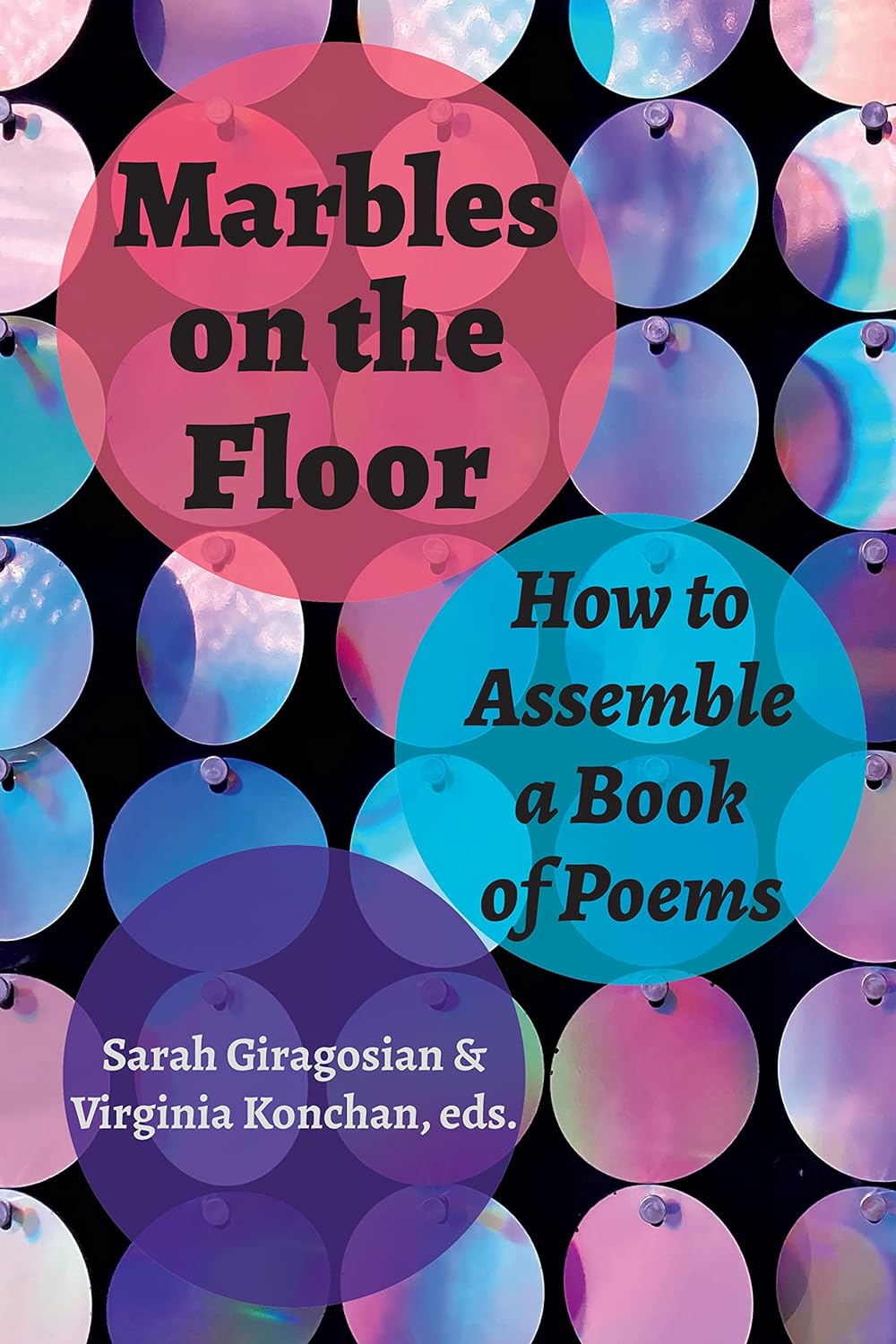
Enter poet-editors Virginia Konchan and Sarah Giragosian, two accomplished poets who have put together Marbles on the Floor: How to Assemble a Book of Poems, the first book of its kind in a number of years. Just published by University of Akron Press, Konchan and Giragosian have brought essays from a diverse range of poets on “the art and science behind the material construction of a poetry collection: Diane Seuss, Christopher Salerno, Karyna McGlynn, Kazim Ali, Cyrus Cassells, Victoria Chang, and many others.
I got a chance to send some questions along to Virginia, and she talked about her own collections, the receptions Marbles is getting, and how the “formal order of a book ultimately comes from within you, and your own lived life.”
I was so excited to hear about this book. It’s been a while since anyone has put out a book-length study on putting together poetry manuscripts. As you point out in the introduction, Ordering the Storm came out in 2006, and much has changed in the poetry world and the world at large since then. Whole generations of poets have come on the scene with their take on the poetry manuscript. As two accomplished poets in your own right, I was wondering if putting this collection together came out of a personal curiosity or desire for figuring out putting together your own collections?
I think both, for me. I loved Ordering the Storm, and found so much wisdom therein. And was curious what a new iteration of that concept of a guide to assembling a poetry manuscript would look like, especially given trends toward the project book and the increased pressure towards marketization (of the self, and books). Interestingly, other than a few asides, the twelve essayists in the anthology didn’t delve deeply into either subject. It’s a craft-focused book to the core, with a mix of lyrical, teacherly, and scholarly essays that speak to each poet’s idiosyncratic vision. By the time Sarah and I dreamed up the anthology in 2020, I had published two poetry collections: The End of Spectacle and Any God Will Do. Both entailed years of wrestling with ideas of craft, form, sequencing, epigraphs, ordering, and intuiting the arc of the books, with help from editors.
The struggle to arrive at manuscripts that felt realized to me (with the invaluable help of editors, what Diane Seuss calls “objective others” in her essay) was so immense–almost a decade for my first book–that this anthology idea occurred to me, in conjunction with my curiosity over shifting trends in poetry writing and publishing, as a possible way to lighten that burden for other poets. Poets speak in a language of metaphor, image, sound, intuitive leaps, and associative logic (as informed by craft): my hope for the book was that its music would reach other poets working through the manuscript assembly process in the same aleatory way that poetry collections do.
What has been the reception and feedback from readers, now that the book is out into the world?
Pretty wonderful! I’ve heard from a lot of poets at all stages of their careers, including M.F.A. and Ph.D. students in creative writing programs, saying how valuable and useful the book has been. Some have said it validated their instincts for organizing a poetry manuscript; others have said it gave them new ideas and techniques to try, as well as metaphors to relate to, as exemplified in Christopher Salerno’s essay, “FAQ: from Press Authors, Graduate Students, and Editing Clients,” an essay that breaks down the process based on the questions and queries Salerno has received throughout his many years as a poetry manuscript consultant and editor of Saturnalia Books. A few readers have said they had a lightbulb moment reading the book, knowing exactly what they needed to do to tie things together. And Christopher Kempf’s generous review in Prepositions praised “those reflections which root themselves firmly in the materiality—the at-hand technical procedures, the specific strategies—of putting together a manuscript.” Additionally, Kempf said “Inter-articulated with one another, the essays here meditate collectively on a tension between order and disorder in the contemporary manuscript, a tension which Marbles metaphorizes in various ways . . . Destined for wide adoption at the graduate and advanced undergraduate level, the collection is a long-needed and generous text, a craft book worthy of the genre.”
This review and feedback I’ve received from readers has been so gratifying to hear, for one because I consider Kempf (author of the scholarly book Craft Class: The Writing Workshop in American Culture, Johns Hopkins University Press 2022) an authority on the craft of poetry, and also because the feedback from readers suggests that the book has a utility and value to readers, which is exactly what we hoped for when we first conceived of the project: an effective guide.
That’s great to hear. I feel that I dodged a lot of this manuscript agita-stress early on in my career, since they were essentially themed collections dedicated by the greatest rock band of all time, Queen, and their song titles were my pieces’ titles and the order was the discography of the band, collected over two books. This was the early aughts, when there seemed to be a lot of overtly pop culture-themed collections, like Denise Duhamel’s Barbie book, Kinky, or Phoebe 2002: An Essay in Verse, the collaborative book by David Trinidad, Jeffery Conway, and Lynn Crosbie. I used to feel like this externally dictated organizing principle was a gift, that I somehow sidestepped the whole ordering the chaos business. Flash-cut to today, and there are just so many options for thematic collections.
There is a school of thought that is out there–I’ll say I read it somewhere on Twitter, because I think that’s where we encounter these kinds of things–that the whole idea of ordering a manuscript book is almost beside the point. We dip in and out of poetry manuscripts at random, the thinking goes, so it really doesn’t matter how the book is put together, other than there are good poems. I sometimes feel this way and read this way, but my urges for order and intention eventually take over. What are your takes?
This subject and seemingly-opposed binary (between an externally and internally dictated organizing principle) is so interesting to me. I had a poetry professor in my M.F.A. who said a poem is nothing more than an assemblage of good lines: that statement was received with a riot of differing opinions, for and against the idea that a poem is not more than the sum of its parts. Extending that argument to the book level, I personally think that a book is more than a sum of its poems. A truly excellent, realized, visionary poetry collection coheres, in my opinion, on both the microcosmic (lines, individual poems) and macrocosmic levels (the book’s conception itself). Louise Glück’s books–The Triumph of Achilles, The Wild Iris, and Averno come to mind–all present themselves as a mythopoetical arc and argument, that organized differently, or at random, would not have the same impact at all. The poems feel contiguous on a very deep, intuitive level.
Obviously this question takes on a different dimension when considering poetry collections influenced by music or music history, or pop culture (I’m thinking of your two first books, which I adore: God Save the Queen: A Tribute, and God Save the Queen II: The Show Must Go On, and Jericho Brown’s Please, organized like a concept album, showing the ways soul and blues music intersect with poetry), or collections for which museum curation, spectacle culture, or the art of looking take center stage, such as exemplars of ekphrasis, Ashbery’s Self-Portrait in a Convex Mirror or Ama Codjoe’s The Bluest Nude. In those cases, the organizing principle is adopted from another art form.
But for books that don’t adopt another art form in their genesis, I’m with you: the urge for order and intention–to impress your aesthetic signature upon a reader, however variously it is interpreted–prevails. After the death of the author and the birth of reader response criticism from the late 60s forward, the onus was then placed on the reader to extract the meaning and experience of the text, not the putative authority or intention of the author. I think this movement now dovetails with the contemporary comeuppance of the consumer (and student-consumer, in higher education) to the point of authorial defaulting.
I read books, especially poetry collections, haphazardly at times, sure. But to read a good book from the epigraphs to the end, and fully take in the book as an indissociable whole, a dreamscape worthy of reflection and contemplation, is I think what good books ask for, deserve, and demand. I think the argument that it “doesn’t really matter how a book is put together, other than there are good poems” is either a reflection of post-literate attention deficit culture, or authorial failure to assemble the book in a meaningful, coherent way, so that the frame and arc have significance.
I love the moment in Kazim Ali’s “Dear Unexplainable” when Ali recounts their thesis advisor, Mark Doty, saying that when reading poetry books “I like the ones that read like record albums.” The music analogies were just catnip for this reader. What resonates in Ali’s piece was the bringing in fellow poets as readers of works in progress and sort of cross-referencing their selections, and deferring to their picks. “The reader always has it over the writer,” Ali writes. That seems to be a theme across the book: poets reading and helping with each other’s manuscripts, helping with edits, inclusion, order, and exclusion. I wonder if this happens more in poetry books than, say, novels and plays and such.
That’s such a great point. I agree, it’s a deeply prevailing theme in Marbles: the enjoining of outside readers and editors in one’s writing process, and the deferral to their opinions and judgment, even if lighthearted (“Get to the point,” says the spouse of poet Alyse Knorr, recommending that she excise the first 30 pages of her book, as mere throat-clearing).

And that’s also a great question, about a reader’s influence on poets versus novels, playwrights, or nonfiction writers. My first thought is that the more dialogic the genre, the more likely a poet or writer is to take in others’ feedback, because they see that feedback as essential to the work. An early reader of a novel, for example, could tell a writer when certain sections fall flat or don’t feel representative of a character; a reader of a poetry manuscript can tell a poet, conversely, when the internal cohesion or architecture of the manuscript feels off, tonally or structurally. I think most poets and writers see initial feedback as echoic of an ideal reader or future audience, which they do their best to internalize, but obviously there are gaps in that projected reception. In my mind, it comes down to trusting the source of your feedback. If you’re lucky enough to have a reader or editor you trust, and whose own work you admire, you’re much more likely to adjust your own aesthetic judgments in favor of their valued and valuable opinion on what is working and what could benefit from editing or revisioning. That relationship is worth its weight in gold.
In my own experience, being a reader for creative writing manuscripts of clients or friends, I always try to suggest edits that are in keeping with the book’s integrity as I see it, irrespective of my ego or personal aesthetic or the other person’s. Those are usually the suggestions that spark an epiphany in the writer, guiding them where they want or need to go, rather than a top-down judgment based on what that person would do “if it were their book.” Because it’s not. It’s yours, and you should only take the advice that speaks to you, and your book, and leave the rest behind.
“Poets are natural collagists,” Karyna McGlynn writes in “Leaping Between Seams: What Analog Collage Taught Me About Sequencing a Book of Poems.” It feels natural to search analogues in other art forms when describing the making of a poetry manuscript–across the collection, assembling a book is compared to everything from architecture and music to dance and sculpture.
“Restless Herd: Some Thoughts on Order,” the book’s opening piece by Diane Seuss, is an example of a piece on craft that not only works as practical advice, or maybe inspiration is the right word here, but also works so well as an essay. Its open form and open heart left me thinking the next time I sit in a room full of my poems printed out, I might actually not cry over the state of my manuscript. My question is a sort of wonky, specific one: the choice to have this essay open the collection seems particularly shrewd and smart. If it had come at the end, it might be read as up-end or even debunking some of the practical and pragmatic essays in the book. Opening the collection, however, its mood comes across as more of an invitation to the idea of order, however the manuscript-assembler might see it.
Sarah and I thought very hard about the order of Marbles, and placing Diane’s essay first was a deliberate decision for the exact reason that you so thoughtfully articulate. Her essay is lyrical, with autobiographical elements, yet offers so much to the reader through that lens of inherited craft, particularly with regard to her own evolution as a poet, and her absorption of Dickinson and Dickinson’s herbarium and fascicles. So many poets including myself have such profound appreciation and reverence for Diane’s poetry, so to take seriously her proposition “that order is a birthright, as is disorder,” for me at least, was a grand permission to make friends with wildness, in my life and writing, knowing that the poetic mind is capable of bringing order out of chaos. The symbols and metaphors she employs (the mares, the stovetop in learning meter, the bra) speak to the poet’s imagination, and the necessary unhinging that precedes formal arrangement. Diane invites us to make sense, and order, out of our lived histories, our suffering, our ghosts, monsters, and selves, trusting the process, a “deeper kinship with the restless herd of the dead,” and our ability to make art out of our lives: moreover, “some fragment of the everlasting.”
The analogic and metaphoric turns so many essays in the book take (collage, record albums, bookcases, bonsais) speak to Aristotle’s truism, that “The greatest thing by far is to be a master of metaphor; it is the one thing that cannot be learnt from others; and it is also a sign of genius, since a good metaphor implies an intuitive perception of the similarity in the dissimilar.” At the same time, the lyric and autobiographical elements in the book, exemplified in Diane’s essay, provide a model of craft, and perseverance, that makes form and closure less intimidating.
“In writing and ordering your poems, you are forging a self. Housing it in a stall of your own making. You are building a bearable myth,” her essay concludes, and I’ve had several readers write to me about another line in Diane’s essay: “Might your book’s arrangement, taken far enough, be you?” I think this has been a watershed moment in many poets’ consciousnesses: the idea that the formal order of a book ultimately comes from within you, and your own lived life.
While outside readers, and hopefully this craft book, can prove illuminating on many levels, it is that internalized permission, empowerment, and confidence that fuels a great book to completion and readership. Only you can write your book. Only you know its intricacies and inner workings. When it finds a readership, the delight is redoubled, knowing that your painstaking efforts were not in vain but worthwhile: there was always a listener in the eaves, and now they are real.
This interview has been edited for length and clarity.

Daniel Nester (editor; he/him) is the author most recently of Harsh Realm: My 1990s. His other books include Shader, How to Be Inappropriate, God Save My Queen I and II, and The Incredible Sestina Anthology, which he edited. He is professor of English at The College of Saint Rose in Albany, NY. Before Pine Hills Review, he helped edit Painted Bride Quarterly, McSweeney’s Internet Tendency‘s Sestinas section, La Petite Zine, Unpleasant Event Schedule, and others. Follow his Instagram @danielnestermfa.


 Pine Hills Review