
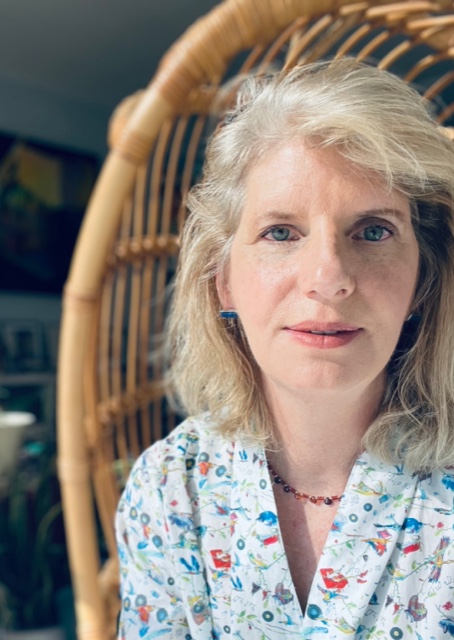
If I were to describe my experience reading Amy Holman’s poetry collection, Captive, I would describe it as an adventure between the bounds of the known and unknown, contemporary and classic, formal and free verse. Each poem of Holman’s has a meaning, a story, a place, and something to take away from it, even if it is just the beauty of the craft itself. Off the page, Amy Holman is a literary force to be reckoned with. She is not only a great poet, but a literary consultant, prose writer, and the author of six poetry collections. Holman is the writer of a monthly newsletter, where she writes about publications in literary magazines, and is a poetry editor for The Westchester Review.
In this interview with Amy Holman, we talk about the relationship between animal and human, reading poetry aloud, human extinction/destruction, captivity, and more of the specifics about her most recent poetry book, Captive (Saddle Road Press).
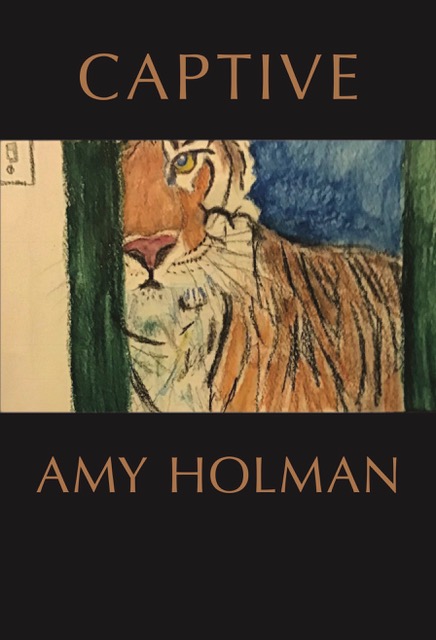
The first thing I can’t help but notice about Captive is the cover. The back is dark and encapsulates this beautifully crafted drawing of a tiger. The tiger is peeking through some sort of space (a window, between bars, some other sort of captivity?) Oftentimes, tigers, much like other big, majestic animals, are subject to captivity in places such as zoos. Why a tiger for your cover, does it symbolize something more?
I’m glad it is eye-catching. The cover is my artwork made with water-soluble pencils and brushes. I placed a tiger in the doorway of a built environment to illustrate the poem based on news stories of a tiger in a New York City apartment. The cover is also the work of Saddle Road’s designer Don Mitchell. He framed it from edge to edge in an opening on the black background. Although it looks as if he may have cut off the image, the entire drawing is included. I made the door frame green to symbolize the natural habitat where the tiger should live. Don tried different background colors, and black won as the most striking. I enjoyed working with him on all the design decisions. At one point there was a version that cropped out the light switch and that also looked good, but as Don said, once you read the poem about the tiger, you know why the light switch needs to be there.
When reading this collection, I decided to partake in something that I have never done before — that was to read each piece aloud to myself. Do you think this changes the delivery of your poetry within this collection, or that it causes no change? Which of these poems do you currently read out loud? Which are you less likely to?
I’m happy that you wanted to read each poem aloud. I read aloud everything at different stages of writing because it helps me with tone, inflection, alliteration, pauses. Not all poems are suited to being read live to an audience. If there’s too much to set up or explain for a single hearing of the poem, then don’t do it. There’s a page of notes in the back of Captive that ascribe to eleven of the poems, to source a news article, work of art, or etymology, and even there I hoped to offer an assist to the poem instead of explaining it. I have not read “Goat Gardeners Take the High Ground in Brooklyn Bridge Park” to an audience because the way I play with roots of words is more easily apprehended visually.
In the early pandemic shutdown, I read aloud, to myself —and my cat Artemis—the entire memoir, Five Days Gone, by Laura Cumming, because it had poetic, beautiful sentences that filled the room companionably.
I saw Gwendolyn Brooks read during early college years at a conference at a Michigan university, and she read her poem “The Mother.” She had a cane and needed to be helped to the stage. I had read that poem on my own, solemnly, with sadness, but Brooks read it righteously, with love and power, and it blew me into another dimension of understanding and reading poetry. Neither she nor her poem was frail. It sounded new and recognizable. Later I reread it and found that her version was right there on the page, bold and obvious in the diction. She had opened my eyes. There was also pain and loss in the poem, I had not misread that. That changed me as a poet, the way I read and considered poems.
From the opening poem, “Snowies and Blues,” it is obvious that humanity, animals/nature, and the relationship between these topics are an important part of your poetry. With this being said, some of the most common things we come back to are human extinction, animal cruelty, the color blue, and whales. I see the whale mentioned in other later poems such as “Social Studies, “The Heart is Quiet,” So, tell me, are whales a favorite of yours? Are they meant to symbolize something bigger here?
Every poem in the book plays in some way with the subject of captive, or captivating. There are other animals in “The Heart is Quiet,” but there are ten poems with whales and/or dolphins depicted or represented. It depends on the poem whether the species is metaphoric or part of an observation, an image. My interest in them started in 6th grade social studies class where we were taught about them—size, intelligence, oil harvested—how they were hunted to the brink of extinction, and how we could use different grassroots methods to run our own Save the Whales campaign. I already loved being in the ocean, but I don’t remember how much I knew about whales before this class—I certainly had never seen one. After that, I never stopped being interested in this giant marine mammal, but it was in my adulthood that I’ve seen and touched a few in the ocean. In “Social Studies” the whale is made out of crepe paper and stakes in the ground, made to the size and shape of the actual species, to teach us how enormous and important these animals are. Mine becomes a protected world that I can step into, away from the one where I feel unacceptable. In some myths, a whale represents “the body, the world, the grave”, and in Roman times, it was the underworld. In most of my poems, the whales are whales that I observe, and they fit into ideas of presence and absence, resistance and forgiveness.
The tendency among some people to want to collect wild animals—taking them from their environments—or ruining their habitats for their survival, are part of the book’s subject. Lapis lazuli and its pigment ultramarine are the subject of two of the “what is captivating” poems—each having to do with value in the ancient world, what’s been hidden, discovered, and revealed. I deliberately added reference to that color elsewhere, such as in “Perception” and “Breathing Space,”—the latter with another whale appearance—as refinements of vision for organizing a whole manuscript. The blue of the particular bridge and the harbor were that particular hue, but I didn’t add it until later. In this book, there’s a lot of what I see that matters enough to write about it, whether I literally observe, or perceive, it.
“Snowies and Blues” introduces readers to a resonant vocabulary and play with double meaning, plus two animal species—whales and birds—that recur, along with that presence and absence again. The collective nouns that the scientists use for the animals they study resonate a positive and a negative, respectively, in those nouns. There are lots of bird and whale species represented in Captive. Egrets are herons, just as dolphins are whales, and at the end of the book, a heron features along with vision. Your question is, for me, about how manuscripts are composed once one knows what the writing is about, and the correspondences among them.
“No One There,” an excellently written villanelle, explains the tragedy of the loss of home due to a house fire. This tragedy dances with the topic of childhood perspective, maybe even a loss in those developmental years. Yet, one line from this poem sticks with me, “How could I be not more than wind?” What does it mean to be wind? How can we not be more than wind?
While this poem draws on personal subjects—an extreme shyness that arose repeatedly in a particular situation when I was a child, and an unsolved arson of a family home—it also adheres to the rules and possibilities of refrains in the villanelle. And all of that combines to make a poem about strong, unsolved feelings, and a tension between presence and absence. I’m without voice, so my knocking must sound the same as wind rattling the screen door. I am a person known to that family, I have presence and do matter, but why couldn’t I speak up and say that I was there? The poem worked once I let go of the desire to find out why I felt the way I did. That didn’t matter. Many years later the winter wind contributed to the fire’s spread in a place close to water. When there’s an unsolved crime, the victim is trapped (held captive) by what is unknown.
Going off of this concept of childhood perspective, I think somewhere else where this arises is “Retreat”. In this poem, we see the childhood wonder of innocence, such as finding toads and riding bikes home, portrayed by the adult mind, with expressive and mature language. In doing this, the poem reminds me of a close-up camera shot that eventually pans out, so that not only the single subject is seen, but the things surrounding that subject are also coming into view. Is the way that you write this intentional?
I think of “Retreat” as a companion poem to “No One There” because I deal with the arson in a similar manner in the poem, as something destructive overshadowing the childhood scenes with toads and toadlets. In that way, perhaps it is cinematic, as you describe. The bicycle has a dark echo in the poem. I have Broadway theater references, and two toys that serve to pinpoint the ages of my brother and me while influencing how I see the toads.
When I was writing “Retreat” and “No One There” I was finding it hard to think of that shore place without thinking of the destruction of it. The toads were in danger, as well: the toadlets drawn instinctually in the direction of what sounded like the beach, and the grown toads falling prey to black rat snakes. Danger and safety. Ways of seeing. There was little we could actually do for the baby toads, and nothing we could do about the fire.
The way you write “A Small Invasion” definitely stands out to me. There is a tonal shift into the more guttural, most specifically in the ways that you describe “gonorrhea muck,” and “of cattails, spent condoms and raccoon dung.” We see the raunchiness of New York City here in these two simple lines, the cruel and realistic humanity to the natural and animal advocate/all that we see on other pages. What is this poem really about?
I think “Rabbit Girl” also depicts an unseemly situation in the city—and the same neighborhood as viewed in “A Small Invasion.” And “Contributor” also addresses pollution—the environment held captive by human action. I did try to write descriptively about the dirty Gowanus Canal, in Brooklyn. (It’s been gradually undergoing government funded and activist inspired cleaning.) I’ve seen that muck, when looking down at the water and the banks, and seen birds and mammals. “A Small Invasion” borrows the circular repeating lines from the sonnet crown and employs them in miniature, with just two parts. I do that also in “Social Studies,” and make it three, in “Perception.” Is there a form that matches this already? I don’t know, but in my mind, it’s a sonnet tiara. The language of the refrains determines where the poem goes but having two connected parts meant I could lean towards different events involving its pollution—the sick dolphin and the cabbies wading through hurricane flooding. In fact, the toxicity of the canal was irrelevant to the health of the dolphin, while diluted and choreographed by the Atlantic and its tides.
The speaker of your poems, who I would be bold to assume is yourself, has a dualistic relationship with nature and human existence. In “Fret,” the poem ends with a direct address to the ocean, where the closing words are “I’m all yours.” Are we supposed to belong to the ocean, to give ourselves free and willing to the water and the nature that makes us? Or are we supposed to give ourselves to society, the humanistically built side of life? Maybe both?
The ocean is important for all of us whether we pay attention to it, or not—think of the pending collapse of the Gulf Stream—but it is the part of the earth that I like to visit and be near, or on. You may belong wherever you feel you do. Some people prefer the woods, I prefer the ocean. In “Fret” I’m playing with the differing meanings of the word, and I’m describing being a “citizen scientist” with a group (The Whales of Guerrero) that was tracking returning humpback whales to the Pacific coast of southern Mexico, around Barra de Potosí. The trip I took was the February right after Trump took office. There was a lot of agitation out there, but not in a fishing boat on the ocean. In the afternoon of the last day when we’d not spotted any whales, after the equipment had not recorded any whale songs all week, we got a song. That meant the whales were right beneath us.
I love the duality in “My Mother Made Herself the Deer with a Broken Leg.” We hear the story of a mom and her divorce, which seemed to affect her negatively. “My mother had suffered a destruction of the self, a divorce, and no one cared,” is the line that brings the reader into the psyche of the connection between the injured doe and the mother. We see the deer living despite its circumstances, people choosing to let the deer live and suffer despite the injuries at hand. With humans, such as the mother, it is hard to let them endure the same things. Where do you think we draw the lines and boundaries between humans and animals? How does your poetry show this? Are we to see this doe as more resilient than humans?
This doe was more resilient than we knew. I’ve since found out that deer can keep going despite a broken leg, that it isn’t the major pain it would be for us. My mother was going through a difficult period of heightened sensitivity and anxiety, and she felt the pain of animals acutely. I write about animals because they are part, and worthy, of this earth, and I write about them metaphorically, too. What we consider to be humane is not only evident in humans, but in many other animal species. I don’t think that our lives should dominate and destroy the environments for survival of other species, although it’s hard to stop that from happening. I was caught in the intensity of my mother’s feelings, trapped by an inability to make her feel better. She was caught in her own trap. She made herself the deer with a broken leg, while the deer ignored her broken leg. For a time, my mother ignored that broken part of herself, too, and got on with her life.
Just peering at the table of contents, it is clear that there isn’t a title poem. Was this move intentional?
Yes. When you say “intentional” you must mean to refer to the stage of choosing and ordering poems in the manuscript. I briefly considered making one a title poem, but “Captive” is a subject that applies as noun, verb, or adjective to all the poems in the book, and I like that better. Unless it is a chapbook, I like to compose collections that give me a broad playing field for subject matter. When there are lots of poems to consider for a collection, it’s interesting to figure out what it is that connects the poems. Two of my poetry books—a chapbook and the previous full-length—have used a line from a poem to stand as book titles. That is just another way of calling to an individual poem while also having it radiate as a theme to others. I didn’t want that title poem or line convention this time.
My one-sentence description of the book is “The poems address what is held captive—wild animals by humans or environmental destruction, the self by fear—and what captivates—discoveries, exposures, and mysteries.”
Stemming from that question, if there were one in this book, “Reckless Endangerment” would best fit this. Here, we are introduced to a multi-page sonnet-like poem that shows the battle between humanity and animality through a tiger trapped in an apartment. We read about a sort of captivity that lingers throughout many of your poems. Humans keep animals in captivity, physical captivity, and put ourselves in a sort of mental captivity, within society. Do you think “Reckless Endangerment,” is your title poem?
“Reckless Endangerment” starts with the description of a photo that was in newspapers in 2003, and later in the poem returns with different eyes to that photo, but also relays the story of Ming, a tiger kept inside a New York City apartment, within a poem structure that borrows elements from the crown sonnet. The poem is laid out over five pages and therefore is the longest poem in the book. The words “captive” and “captives” appear in it, and the tiger in an apartment made a dramatic and curious cover image, but I contend that there is no title poem in the book. All the poems matter and the reader can choose which one carries the whole, if needed. No poetry book I’ve ever read—unless it’s written as one long poem—has ever given me just one poem that stands in for everything. Crime, and the strange ways in which people behave are two news sources for my poems, and a man choosing to create a Garden of Eden in his Harlem apartment with an apex predator in the mix, fits both. The poem isn’t only about the tiger, it’s also about what we see, and believe, how we are divided and choose to unite, lightly touching on the predator nature of police, and the kinship of human migration. There is a line “All we know is who we are and how we are treated” that feels like a continuation of “Where we belong is who we are” from the poem “Fields of Loneliness.”
I just want to say that “Drawing Out a Drawska Vampire,” is my favorite poem. The consonance used here is brilliantly written, and I think this is beautifully written. What was your inspiration here?
Thank you for saying that. I like knowing which poems speak to readers. I do give writers the guide to some of my weird poems in the back under “Notes”. This one is really a play on language and resurrects, if you will, the life of an un-monstrous man adversely affected by superstition. It was inspired by an article on the isotope analysis of the skeletal remains of 19th c. cholera victims in Poland who had died so quickly they were believed to be vampires, and thus strangers. They weren’t either. Their dead bodies were given vampire burials—sickle collar, rocks stuffed down throats. The families must have been shunned, too, like cholera wasn’t bad enough. The isotopes of our teeth and bones will be the same as the isotopes in the ground where we come from, so by analyzing the isotopes of these unfortunate long dead, the science settled everything.
Although we are in what is considered “post-Covid” times, “The Blows,” brings the natural sea into urbanity, and back to the COVID-19 pandemic. Was this poem written during the pandemic? Where does this poem bring you back to?
You know, I had thought of having a collection called Captive before 2020, and kept writing my animal and fear poems, and then as the year kept getting worse, I ditched it for awhile. We were all captive for a whole different reason and I didn’t think I was going to write about that. However, I did have that experience of being on another whale watching trip, in northern Mexico this time, two weeks before the shut down in New York City, where I live. I worked on versions of “Crosswinds” during the pandemic, and part of one version had language and images that eventually became “The Blows,” and that was written in August and September of 2022. Those two poems reference a trip to the Sea of Cortez and the San Ignacio Lagoon in Baja, and the return to Brooklyn, New York five days before curfews were set and offices and everything but essential work stopped. I had tried to make a pantoum with “The Blows” but couldn’t get far enough. Remnants remain.
Your final poem, “Intelligence,” ends with, “At the optometrist, I, too, learned the brain chooses how it sees…” Here we are brought back to a sort of open-mindedness. It’s a beautiful ending. Why did you choose to end with this poem? Is order and structure something you take into consideration when you create a book?
Back to one of the sub themes of my writing, and this book: ways of seeing. I started the book with a poem about snowy egrets and blue whales, about resonant naming of species, a kind of abundance and scarcity, and I wanted to end with either a marsh bird or a whale. Peppered throughout the book are poems with other whales, other birds, and a sense of human intrusion, but the great blue heron in the Adirondacks is unfazed by the human world of railroad tracks and Amtrak trains. In fact it has a fast and adaptive focusing eye, is one of the smartest birds, and may have noticed me in the window of the train easing past. “Intelligence” is both intel and brain in this poem. My eye —perspective, capture—is in this poem, too, and I wanted to end the book on a positive. We are intrusive but we also don’t matter that much. But what I see and care about matters.
This interview has been edited for length and clarity.

Samantha Zimmerman is an editor of Pine Hills Review and is an all-over-the-place poet with a passion for all things experimental and confessional. Her work has been featured in Sledgehammer Lit, Bullshit Lit, Discretionary Love Magazine, BarBar Lit, and The Afterpast Review. You can keep up with her on Twitter @samthezim.
 Pine Hills Review