

When I was young, my family would take yearly trips to Brooklyn, where my father was raised and spent many years of his life before he decided to take on upstate New York. On these trips, my siblings and I were always so amazed at the tall buildings, leaning our heads against the class car windows, chins angled up to see where the top of skyscrapers met the sky. We grew to adore Coney Island’s boardwalk, the frigid breeze off of the Atlantic Ocean, and realized just how big the ocean may be, and how small we really were. I think I grew to love it a little more than my brother and sister. Promising myself that I’d play my clarinet on Broadway one day, and have my name in shining lights somewhere, I didn’t know where, but somewhere. In the promise of this all, I’d like to say maybe there was some glitter, even if the life I live differs greatly now.
While reading Bonnie Jill Emanuel’s debut poetry collection, Glitter City, I was transported back to these days of longing for a life different from the rural one that I was raised in. I was introduced to glitter not only as a perceivable, plastic craft item that was hard to clean up, but as our state of being as humans with diverse experiences in our own glitter cities, something that might linger, maybe even after our own time here. Emanuel’s debut collection not only talks about the bounds of glitter, but naturalist themes, moons, childhood memories, and so much more, using the art of imagery and description to create a portrait for each poem.
Bonnie Jill Emanuel is the author of Glitter City (Cornerstone Press). Her poems appear in American Poetry Review, SWWIM, Colorado Review, Mid-American Review, as well as other publications. She holds an M.F.A. from The City College of New York, where she received the Jerome Lowell DeJur Award in Creative Writing and the Irwin and Alice Stark Poetry Prize.
In this interview Bonnie Jill Emanuel and I discuss where we can find glitter, the use of flowers and nature in her poetry, tangible imagery, a world of glitter cities, and what is next for Emanuel.
My favorite question to start out these interviews is where are you when you answer these questions? Mentally, physically, spatially? Where would you rather be?
Right now I am in Cutchogue, NY, looking out over a field. Mentally, physically, and spatially. Honestly, there is nowhere else I’d rather be.
Glitter City is a part of University of Wisconsin’s Cornerstone Press’s Portage Poetry Series. Since a portage is a pathway, what was your adventure like writing this book? Did you write it with the mindset of it being a collection? What was your publishing process like?
The debut collection is a funny thing. You’re composing the first book in your head for a lifetime before one word even finds its way to the page. The actual poems in this collection were written anywhere from ten years before the book came out, to right before. I can’t tell you how many times I pulled pieces out, added pieces in, rearranged the parts, and retitled the project. It was endless. I submitted different arrangements of the book for about a year, but this version—as Glitter City—was only out in the world for a few weeks before it was accepted for publication.
The trend now seems to be toward themed manuscripts, but I don’t think a poet necessarily writes to a theme. It is always best to let the poems themselves chart the course, and then perhaps arrange them in a relational way later. To your question, I didn’t write the book with the mindset of it being a collection.
Your portage/pathway analogy is an excellent one. The writing process, publication, and post-publication period each feel like a pathway to somewhere mysterious, to some unknown, astonishing destination. Same way as when you begin to write a poem or story you can’t predict where it will land.
Portage, or portaging, is also the act of carrying a boat or cargo between two bodies of water. I hope that my poems don’t have clear beginnings, middles, or ends; I would rather each move or exist in an indefinite, in-between space.
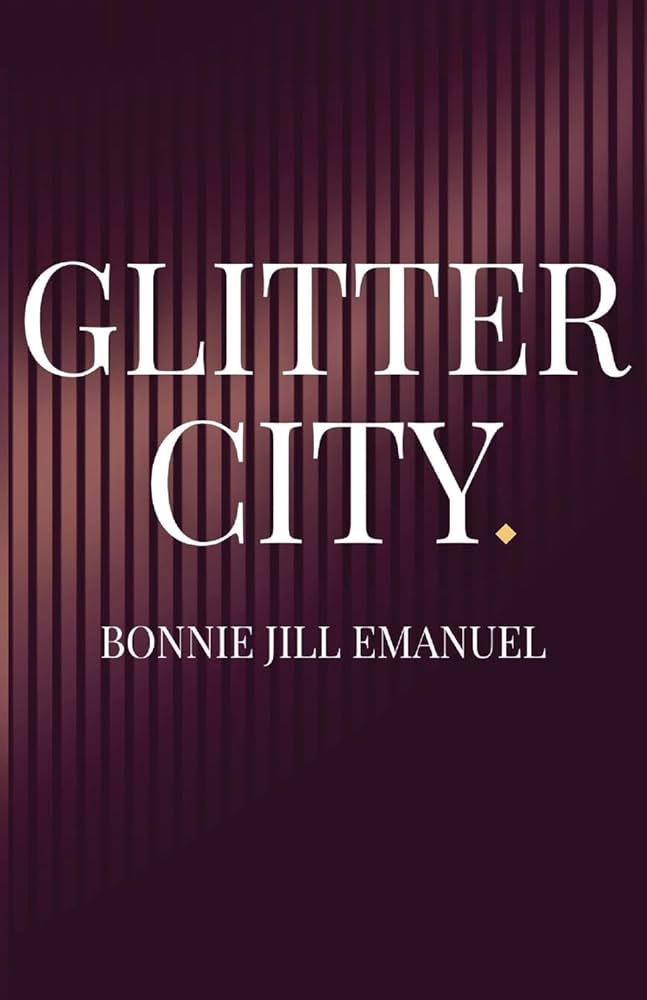
The title, Glitter City, just makes me think of a snow globe with the New York City skyline in the background, glitter covering the buildings as it begins to settle to the bottom. What made you choose this title? What is a “glitter” city? Where can we find the glitter in your book?
I think, first, the poems themselves might be the glitter. But in part my title is meant to be slightly tongue-in-cheek.
In the penultimate poem, “Fourth of July Over 8-Mile Road,” the speaker declares: I give you / all my glitter. Glitter can represent a beauty that is not real, a layer, a mask. Our culture puts so much focus on the visual. But if the poems are the glitter, the reader must look beyond the external.
I love your New York City snow globe. During the pandemic we thought about what was in the air, the unnamable, the invisible floating particles, the many things we cannot fully understand. In my book, glitter is as much sequins on a gauze skirt, or dandelion pappus gliding in wind, as it is a feeling that might inexplicably transmit from one mind to a willing other. Your idea of the glitter settling to the bottom makes me think of pollen in the spring, or ashes, or dust. Is there a sort of imperceptible glitter in regeneration? I think so.
Perhaps the whole of life can be thought of as a place or state of being, and if so we all exist in a sort of Glitter City stardust.
Nature, including flowers, throughout your pieces, especially in the first section, is especially present. I admired the use of dandelions and moss “Still Life With Glitter.” These two things are something that many people see as a nuisance, but your writing brings a beauty to these natural things being mixed in with the urban scenes. I couldn’t help but think of Stacy Alaimo and her book Bodily Natures: Science, Environment, and the Material Self. If you haven’t read it, I definitely recommend it, definitely a good ecofeminist read! Do you draw your writing of nature from an influence? What is the importance of nature in your poems?
This is a great question. I grew up WITHOUT a lot of time spent outdoors, I was an indoor kid with indoor parents and indoor activities. I inhabited indoor spaces: the museum, the library, the movie theatre, the bowling alley! I suspect it is some longing for nature that has driven the poems. I’m so glad you asked this question because it really made me think.
As for the dandelions and moss, they are always so rangy and messy. In the poem you mention (which was one of my favorites to write!), the overgrowth on the patio is “a reminder of something wild / & fugitive” for the narrator. The weeds are perhaps tokens of movement, and freedom. They are incorrigible, and fantastically so.
I have not read the Alaimo book—but you can bet I will now. I googled and am fascinated by what I found, including Alaimo’s trans-corporeal understanding of matter. Yes, those arguments intersect with my topics, and with the self or sense-of-self in my poems as intertwined among all other natural things, yes. Thank you for making this incredible connection.
I want to say that you have such a beautiful way of setting up these images and scenes in your poems. It is almost as if the reader could reach out and touch it, that it’s tangible. One of my favorite examples of this is, again, “Still Life With Glitter.” Some of these include the description of the backyard, but my favorite being, “I tell my husband I think/ the tall trees are giant crayons in a box, but/ just the greens—.” This is such a unique take and I have never heard of trees being described like this, but now, as I look out my office window here in upstate New York, I see it. What drives your imagery?
Ah, I’ve spent time upstate, and those trees do resemble the crayons! It’s so beautiful there. I’m happy thinking of you looking out the window. It is hard to say what drives my imagery. If I gaze at something long enough, and often enough, these likenesses just pop into my head. And maybe the more ordinary the object is, the more unique it may become on the page. The tall trees you refer to are Arborvitaes in my yard. I see them every day. Thank you for what you are saying here about my imagery.
I’ll go a little off-topic here and add that so many of us don’t feel as if we always truly belong with others, or as if we are fully connecting in these human relationships we are “told” we need. In this scenario, there is a place for objects in nature and/or animals other than humans where a different requirement exists when it comes to connecting. Requirement isn’t the right word, but you know what I mean. In a poem, I can add a layer of meaning by projecting via descriptions onto an Arborvitae, for example, where the tree is almost another human, maybe even another self.
Let’s talk about the moon, or we should say moons, in your book. There is the Harvest Moon, along with a list of other full moons (“Grandmom’s Round Moon Cookies), the Pink Blood Moon ( “Wolf Peach”), the Yellow Corn Moon (“Color of a Roadhouse Porch”), the Wolf Moon (“Poem on a Highway”). I see these moons as a sort of cyclic imagery to tell time has passed, this also includes mentions of different months and seasons in your work. Are these elements here for a reason? Are they here as the part of the timeline of this story? Is this a story with a cohesive timeline?
Another great question that is making me think! I see the book as a loose narrative that begins in the pandemic, and works its way back in time. Part 2 makes more use of abstraction, is more hallucinatory in parts, and does contain some poems set in a childhood. The narrative winds, to mimic memory.
With each appearance in Glitter City the moon plays a different role. It is the circle of life (“Grandmom’s Round Moon Cookies”), the uncharted or exotic (“Wolf Peach”), and a romantic ideal (“Poem On A Highway”). In “Color Of A Roadhouse Porch” I think the moon might be a guardian or protector, ever-present. The moon, or a sturdy shade tree for example, can be a wonderful stand-in for an absent caretaker in a story or a poem. Magical realism is everything.
Now I want to talk about my favorite poems in this collection, and believe me, it was hard to even get it down to two. I have to say the two that have my heart are “Pendant” and the closing poem, “Apollo 11.” In “Pendant,” there is a flashback to what I assume is childhood, and confronting the woes of lost childhood/ the desire to escape a place that brings back the dark parts of childhood triggered by this gift from a friend. So, tell me, what is “Pendant” about, as best as we can accomplish that? Where are we and where are we going? Who is Marguerite?
Well I think you already understand what “Pendant” is about. You have captured so much here in your question. The poem is one of my favorites as well (!) and I love to read it aloud. It is a coming-of-age narrative set in an actual metro-Detroit subdivision of houses called Sherwood Village. This is a sort of packaged square mile of brick ranch homes surrounded by strip malls, named after Robin Hood’s legendary forest. Here was the 1960’s American dream come true.
But yes, exactly as you say, there is the darkness inside the house. Outside, the shrubs are pruned but something on the inside is amiss. Yes, there is the friend, and the gift.
I had a childhood neighborhood friend and we always played at her house, in her basement of toys. She lived just a few streets away. One day, I brought her an orange and yellow leaf… made of plastic, of all things. I don’t know what magic ever happened, but I told her it was The Magic Leaf. Her name was Elise (not Marguerite!), and she had electric red hair, and she was quite brilliant, both on the inside and out.
I have a dear friend now, blocks away, New York, with the same hair. She is an artist, and quite beguiling, and she gives me the most beautiful handmade gifts.
As happens in poems, my Marguerite is a mash-up of the two.
Thank you for having so many favorite poems.
The Apollo 11 event is known to most people as the space event in which Commander Neil Armstrong and Pilot Buzz Aldrin landed on the moon. Your poem, “Apollo 11,” isn’t about this event, but a fragmented poem, referring to a story of an overdose/ poisoning that happened to someone, a female, seemingly a mother, and then a tonal shift, to the third fragment with two powerful lines, “It’s as if you can’t hear me: I dove heart first into the sea.” The use of water when talking about big emotions, oceans and lakes especially can be seen here. How do you dive heart first? What is the purpose of your use of water in your work?
Yes, the water, the water. The big emotions. Thank you for asking about this. Thank you for seeing this.
I’ll start by saying that humans come from water, we are water—and I know I am stating the obvious here. A retreat to water may be a return to our own essence.
Water is also of course shapeless. And its physicality is pretty much indescribable. And it is not ever inert. There is this quote from the movie “The Shape of Water”: Unable to perceive the shape of you, I find you all around me. Does it refer to a spirit, or a form, or even a manifestation? I don’t know, but there are so many things we cannot rightly find language for.
In this poem our speaker, a youngish girl, is not in control… still she is powerful. The water is a sea. Picture the Apollo 11 lunar module upon return, splashing with great force into the Pacific. But the girl does a dive.
Looking back, I think the sea in the poem is the uncertain, the world, the future, a huge, omnipotent fate. This poem’s speaker is unafraid.
This is one of the earliest pieces written. In the later poems I believe the words, the lines, take over—if that makes sense. Said differently, as time goes on the voice gives itself over more and more to the poem, the world of the poem.
So, Glitter City is not just about New York City, as I had expected it to be, but also talks about time spent in a city in Michigan! Do you care to talk about your time in these cities? Your writing experiences here? Do these different cities glitter differently?
Well, Michigan is where I grew up, and New York is where I find myself now. No matter where I am writing, the lightning-quick memory flashes in my brain, the recollected snippets, all of these embedded pictures of landscapes and rooms and colors and shards of stories, derive from childhood.
The poems’ cities and sites all do glitter and glint, but I think the voice is the true source. Perhaps the speaker in Part 1 is more evolved, more classically ruminative, and in Part 2 she is rawer, younger. Irrespective of location, there is also always that ineffability—in the voice, the words, the poem—that is the glitter. You know what I mean. That said, the backdrop does set the tone. And it is an opening.
As a writer who has just recently published their first full-length collection of work, what advice do you have for writers looking to publish their work? What is your writing muse? What is your writing process? What’s next for you?
This is the advice one hears over and over: keep at it. And it is true, you must keep at it. Be determined. But also, do trust in the journey of keeping at it in whatever way is your own.
I work best with deadlines. I need an exterior task scaffold to hold me accountable to actually sit and focus on the writing, to do the revising, and to send off the work. Getting started is hard for me, so workshops and writing groups are imperative. Once I have a set of poems I feel are complete, I use a paper calendar where I’ve marked the submission windows of the journals I’m interested in and I do my best to stick to it. Without my calendar, I’m lost! I even have writing and submitting times blocked out every week.
I think I am most “myself,” when in the midst of a creative writing burst. During these times, I (happily) say no to other commitments, and immerse into my own head. I haven’t been able to bury myself as such, of late, and I’ll admit to feeling unsteady. I cannot wait to get back into creating. My next project involves poems in the voice of someone else… a painter, famous, I’m not divulging who!
This interview has been edited for length and clarity.

Samantha Zimmerman is an editor of Pine Hills Review and is an all-over-the-place poet with a passion for all things experimental and confessional. Her work has been featured in Sledgehammer Lit, Bullshit Lit, Discretionary Love Magazine, BarBarLit, and The Afterpast Review. You can keep up with her on Twitter @samthezim.
 Pine Hills Review