
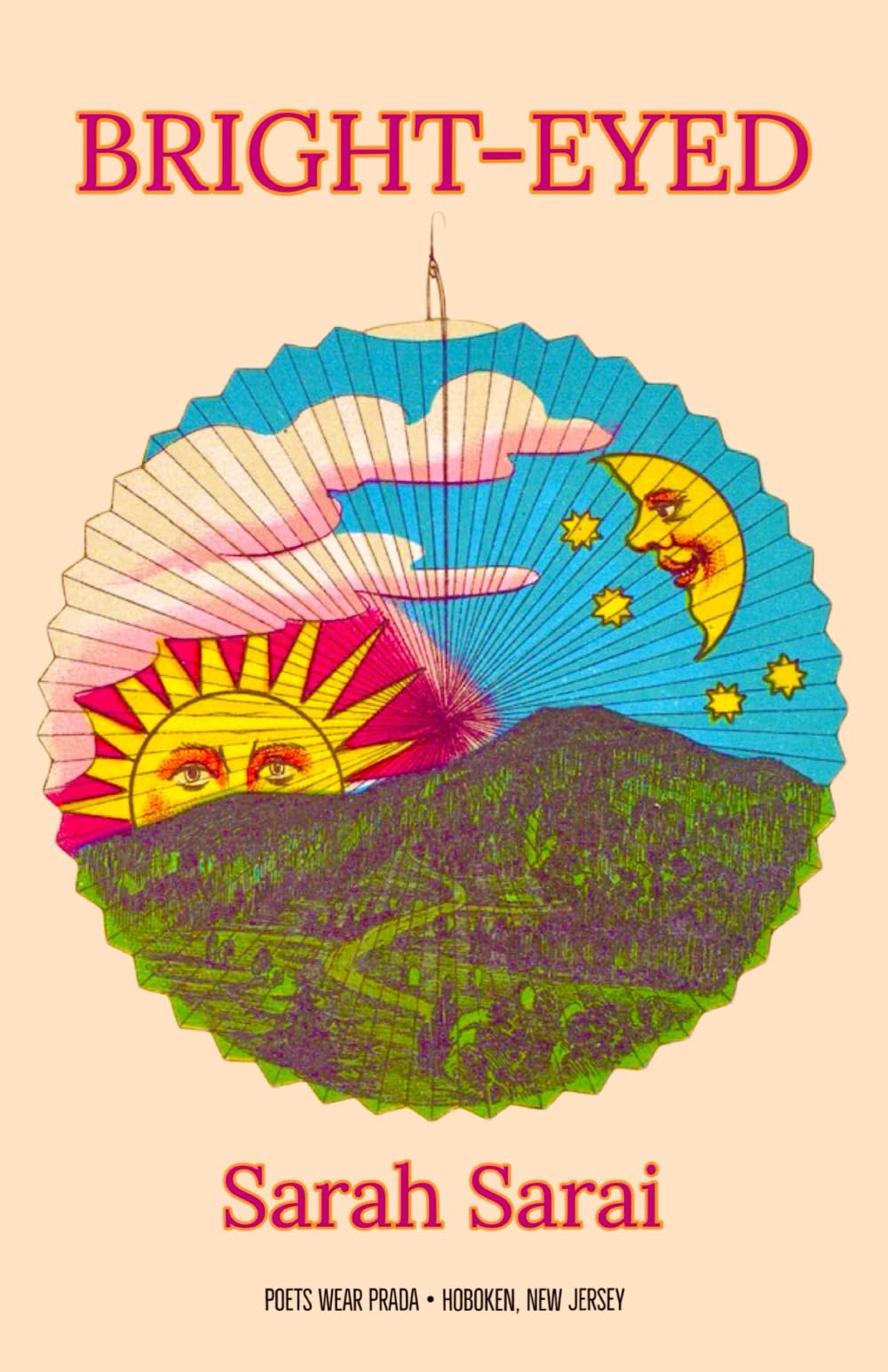
That Sarah Sarai’s newest poetry collection, Bright-Eyed, appears in the current political climate in which we find ourselves has allowed me to sit and read and reflect on how true it is that history repeats itself. Sarah Sarai writes in a voice that that speaks out to both the present and future. Clear-eyed and precise, Sarai’s writing bursts at the seams with familial migration, race recognition, and discovering sexuality/sensuality. Sarai’s poetry is a must-read for anyone who favors the emotional, and introspective, with, as we discuss here, a callback to the Beat Generation, among other influences.
Sarah Sarai is the author of Bright-Eyed (Poets Wear Prada 2024), That Strapless Bra in Heaven (Kelsay Books 2019), Geographies of Soul and Taffeta (Indolent Books 2016), and The Future is Happy (BlazeVOX 2014). Along with being a very prolific fiction writer and poet, her work can be found in New Madrid, Stone’s Throw, South Dakota Review, Mississippi Review, The Threepenny Review, among others. Sarai is also the author of four chapbooks O You of the Cotton Pajamas! (Dusie Press 2016), The Young Orator (Winged City Press 2014), I Feel Good (Beard of Bees 2013), Emily Dickinson’s Coconut Face (Dusie Press 2013), and has been the recipient of many awards. Having taught at Pace, Fordham University, and in the CUNY system, Sarai now works as an independent editor.
Pine Hills Review has published two pieces of Sarai’s: “How Brillian Beethoven” and “Low Life, Malibu.”
In this interview, we discuss Western migration, vivid images of the sun, the expression of sexuality through means of bodies, associations with modern history, and much more.
One of my favorite questions to ask the writers that I interview is where are you? On the sunny Californian coast, back east, or somewhere in-between? Where are you mentally? Where would you rather be?
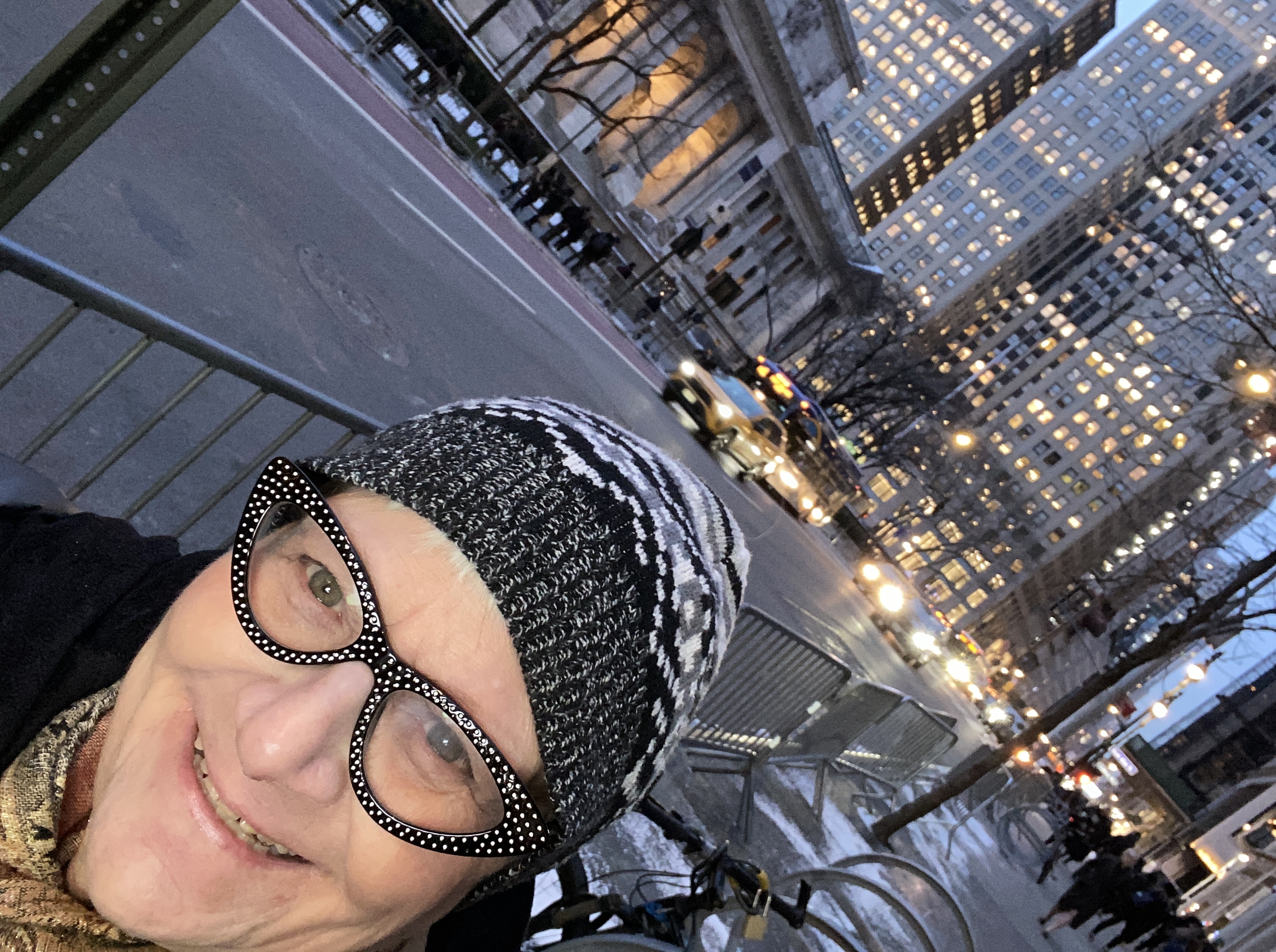
I’m in the east twenties, near the Armory, in a neighborhood that’s resisted the worst of gentrification N.Y.C. spits out. Mentally, I’m testing a spin of cities, countries, planes of existence. When I was eight, we moved, Mom, Pop, two of my three sisters (the third was in college), me, to California: the San Fernando Valley. There was so much sky!
Where would I rather be now? Mexico City, for one. After high school, I wanted to live above a bar in Salinas—a Steinbeck thing. I was headed to San Francisco State. Ended up at a college in Santa Fe. Family stuff before Freshman year ended; I left early; L.A. was out, so I lived in San Francisco with a marvel of a friend. Back to L.A. Ten or so years divided between the Crenshaw District and Echo Park. Ten years in Seattle.
Never wanted to live in New York; figured two years, grad school, and I’d be out. Not the case, but not too shoddy, either.
We are presented with the title Bright-Eyed in an intense shade of red posed over a beautiful image of the sun and the moon, along with a few stars peering over a beautiful landscape of luscious greenery. Talk a little bit about this. Is this image of a sunrise? A sunset? What symbolism goes into this?
The cover art is a chromolithograph—a type of color printing—from the late eighteenth-century. Germany. The unknown artist presents a deadpan solar gaze, flirty moon, and foothills a depth of green you’d be unlikely to see in Southern California. A Prussian green, perhaps. I can’t speak for Anonymous, but for me, it prefigures, observes, in fact, my family’s move from N.Y. to mythic Los Angeles in 1957. In a 1957 Chevy Bel Air, let it be known. A drinking buddy of my father’s offered him a job and all of a sudden we were moving up. Drove cross country on Route 66, a bit of performance art in retrospect. We were a joyous unit offered an opportunity to leave the past in and start anew. The past becomes the present, still, “Go to the limits of your longing. // Let everything happen to you: beauty and terror” (Rilke).
Over the years, my pop and I walked the piers up and down the California coastline; two Aquarians, walkers, abiding by a geographical limit of oceanic importance. The patio furniture and other West Coast wonders in our little tract house were aware. From Bright-Eyed: “This Poem is / an exploration of / the fallacy of / indoor-outdoor furniture / pursuant to / duck droppings on a / squeaking two-seater” (“Patio-speak,” DMQ Review).
Speaking of the sun, there is a lot of sun imagery throughout your book. From the lingering sun in “Things always work out.” to the imagery of the sun and the eye in “A Vegas Vegan,” the reader is immersed in a heliocentric collection of poems. Day, new beginnings, natural light, hope, spirituality, and most importantly hope. All of these things and more are found in the lines of your poetry. What is the sun to you? A simple celestial body, or something bigger?
Sun. Beatification—“Blinded by the Light.” Sorry to go all Manfred Mann on you. I remember telling a congregant at the New Church (in Murray Hill), a church influenced by writings of Emanuel Swedenborg, with whom angels conversed, that I was half-Jewish, half-Christian Scientist. “Then you were released to walk” is what they responded. Yup. Either way I turn, someone’s gathering the shards to return us to wholeness (my pretty lousy explanation of tikkun olam), or attempting to transcend the body, which can be a sinkhole of pain. Can be; has been.
I’m “split at the root,” Jewish and Christian, like Adrienne Rich. Her famous essay. I bowed out of Christian Sunday School when I was thirteen or fourteen. I always loved European art, captures of belief, pain, death, and grief. Oh, the grief. Decades ago, a friend told me I was a “preliterate Christian,” a term Bill Moyers, a highly intelligent television moderator of old, used in interviewing Joseph Campbell (who had synthesized Jung’s teaching). I come to that light through the art, at least in part. It’s art, imagination, much bought and paid for by the man. No question. All of us suffer and get past your slithery aversions, people, to this art.
As for Vegas. Well, there you have the limitations of the sun, which is full-on in the desert; and still people flounder. It’s a way-station kind of thing. I saw Fats Domino in a lounge show in the very early seventies. I played the slots, once, only once, coming from L.A., and hit a modest jackpot. Slinked out of a wedding chapel, also having driven from L.A., my beau in tow; it was just too cheesy. Vegas is background, a screen set, just there, a domain of a god, as I write, of the “sunken and found” [“A Vegas Vegan,” Moss Trill]. In the challenge of desert, images rise (in my inner eye) because that’s what they’re bidden to do; the Mojave’s embedded with monoliths, plus, if I may, Vegas is a place to get baked, per The Hangover.
There is that version of Los Angeles being ever-shiny and volleyball-in-the-nude-ready. Without a total loss of my family’s old country intensity and historic memories of grandparents, my family became new in L.A. Not hip, not jazzy, not loose or cool, but still we’d tossed our square-toed pilgrim shoes in the Long Island Sound. In New York, I was related to the old country, Russia and Sweden. In L.A., it was only parents and sisters, all of us born in the U.S. for better and worse. You need all the Russian dolls uncorked to find the littlest one, ready for the new. L.A. is a marker of the universal desire to blend in, to become Sandra Dee.
“O You of the Cotton Pajamas” immediately caught my attention with the plane symbols underneath the title. There are multiple uses of whitespace throughout this poem. Another poem where I see symbols is “It Is the Body that Gives Us Away.” What do these symbols and white space contribute to your poetry? Is the implementation of symbols in these separate poems for different reasons?
Those two poems were written in different emotional time zones but meet up in the same neighborhood: The Crenshaw District, where my sister and her husband lived and raised kids. Pete was Black, the kids were Black. Mixed but Black. From my early teens on, my folks and me visited nearly every weekend. The lure of the grandchild. Weekdays in Burbank (our third and final stop, as a family, in L.A.), the CD on weekends. Beautiful Sylvester (check out the Joshua Gamson bio) was raised in the Crenshaw District closer to Inglewood. Will Alexander, poet of remarkable beautiful work, from the Crenshaw District. Probably a zillion others but rapper and true activist Nipsey Hustle comes to mind: supporter of Destination Crenshaw.
“O You of the Cotton Pajamas” began life as a wee, fold-out chapbook I created under the Dusie Kollektiv imprint. (We mailed chapbooks to each other; it was very cool.) As for “It Is the Body…” I wanted to figure an inroad to representing my Black relatives. Haven’t gone far with that. I have produced few relevant poems and one, and only one, short story, which is about hanging out with my sister (who wouldn’t smoke, drink, or dance once she married), and my brother-in-law (who would do all three plus be a swell dad and working Joe), their beautiful genius kids; me. Buy Bright-Eyed (Poets Wear Prada). Read the poems.
I’m going to describe a short story. Okay? “A Dog Barks”: very short. The narrator’s sister is working on some craft at the dining room table and is on the phone because she was always on the phone. Her husband is in the living room, watching the game with a friend; smoking a joint. The me-person is observing from the threshold. Taking a hit when offered. There’s back-and-forth, confusion, belonging, estrangement. Like that. So the story finally landed in a small journal, but prior to that, it was rejected by The Seattle Review. That’s okay. My point here is: Charles Johnson wrote something like “good dialog” on the slip. Yay, me.
Addendum: Ninety-nine percent of my short stories have been published in journals. My hope is to get them collected before I move on. And my two novellas. Can I get an You go girl? Can I get a grant?
“Souls in the Penalty of Flesh” [in Ethel] is a flash to the few weeks after my sister phoned home. She left immediately after high school and within a year, married; her husband was Black. As is the wont of young brides, she became pregnant; and the couple knew it would be easier to live in L.A. than on the east coast. I knew she phoned but other than that was told nothing. God forbid there be direct communication in my family. Twelve-years-old and I began sleuthing, “studying / the ambient inhalation of a family.” I was living a mystery, watching, listening for clues. I recognized I was a silent detective; realized I enjoyed, still do, exercising my insight muscles. Also. While home could be a battlefield (nothing physical), lotsa emotion, I never heard or saw racism at home. My parents weren’t liberals, politics wasn’t the focus for them that it can be for me. But the training, good training it was, was that we didn’t see difference—the whole We’re all God’s children thing—was fact. The weirder training, from my Christian Science mother, was that we barely saw bodies. Onward.
As I was saying, I realized, as evidenced in that poem, that I loved this kind of noticing clues and assembling the truth, exercising my insight muscles. To this day. Maybe this is part of my split-at-the-rootness. Another student in grad school, after sharing the backseat with me during a grocery run or whatever, said I was definitely half-Swedish and half-Jewish. What’s that about?
In Bright-Eyed the reader can see a broad contrast between your prose poetry and other poems. Some of these poems include, “Complexities Run Interference,” “The Shiny You Have Missed,” and “My Father Sleeps Rough in His Dreams.” What do you think your prose poems bring that normal stanza-based poetry doesn’t?
When prose poems were becoming a “thing,” at least locally, I took to the challenge; did all sorts of futzing and figuring, Microsoft Word-manipulation with paragraph marks and left-aligned margins to see what constituted a prose poem, a true one which earned that nomenclature and wasn’t simply a reformatting of lines without meaningful intent. I was at times skeptical and in my trials, wondered if the poems were no more than characters in a broad stage comedy, racing backstage to change clothes, become new characters and zip back onstage.
It was good to experiment. It is good to experiment but I lost interest in ascertaining a formula; the poems and the energy behind them rallied. While I can imagine a free verse version of “My Father Sleeps Rough in His Dreams,” I made the right choice. That “paragraph” of a poem coheres around the narrator’s search; she races home to a living bifurcation, her parents, each with their own pain and history struggling to make themselves whole.
Prose is solid yet flexible and often reliable, a well-engineered skyscraper able to withstand gales, a Tupperware container keeping events fresh. Trivia: “His bluejeans were baggy like a movie farmhand’s and held up with rope.” I was creeped out while sneaking around (real life) the Toluca Lake Country Club; when writing about that, years later, I had Henry Jones in mind, from the movie The Bad Seed, and Tom Ewell, just because.
Here’s an on-the-spot idea. An experiment, okay? Imagine Jane Eyre as a prose poem. While there’s enough struggle, cruelty, and nobility therein, I don’t see it as other than a novel. Embedded with cruelties and bravery, and personalities though it is, there’s consequential logic to the writing. In Wuthering Heights, however, the sister (if you will) narrative, jeez, the heath alone is an epic poem. It’s part horror and hugely romantic. Both novels scream the pains of social inequity. Both have been rewritten, reformatted, reinvented, and will continue to be.
Your poem, “Not Me, It Cries,” reminded me of Allen Ginsberg’s Howl “Part I.” “…my smile a loop, a cache of memories tooling outskirts of best times ever, gone days, manic when manic was friends who could spot a grand weirdness of bravery…” You write about the past coming into the present, a beautiful way of managing flashbacks through poetic means.
What is the importance of writing about the past? Who do you find yourself inspired by poetically? How has this and your craft changed over time?
I just grabbed Ginsberg’s “A Supermarket in California”—the first poem of his I read, long ago. I admired the poem when I was a civilian, decades before I started writing poetry. But you said “Howl.” That lamentation; that observation; that translation of our culture (“& the mustard gas of sinister, intelligent editors”). Comparison with Ginsberg is appreciated, as well as with poets I very much admire, including Stevie Smith, June Jordan, Akhmatova, Szymborska, Ai. And all those guys, too. Men write poetry! Who knew? So many others, great and good. What a world.
All well and good but I was in my late forties when I began writing poetry; along the way, reading poetry had been a constant. That’s one of the few things I really really like about myself —that I read poetry because I liked poetry.
In “Not Me, It Cries” the poet recalls those specific moments when an uncomfortable (or not) memory shakes us; insists we wake to revel in self-blame and regret. I thrill at the phrase (which you quote here) “when manic / was friends / who could spot / a grand weirdness of bravery.” Arguably silly and arguably not-so, that impulse, that acting out of a trait which warriors consider to be their territory: bravery, a motion of impulse or sacrifice not scorned, an “originality manifested.” I miss that self and I miss having friends who admire my flukes. Too many want to talk about careers. Really?
As a confessional poet who writes a lot about her personal life, I was drawn to your poem, “The First Time I Had Sex.” You bring up topics of defining womanhood through sexual encounters, embracing bisexual experimentation, and positivity to the expression of sexuality through means of bodies. Do you find that this poem has a bigger purpose? Is it meant to share a bigger message? What is that message?
I’m eager to read your work, Samantha! I suggest “The First Time…” invites self-love and self-acceptance: “Our bodies are soft foothills / in spring. The Sun sends / its warmth to grass greening / on soft foothills in Spring.” I could platitude my way to heroic encouragement about being honest about one’s dalliances. But [when] I wrote it I was too old to care. Also, I don’t tend toward “abouts.” It’ll take me years to understand how to approach this, but I’d like to write about a particular difference of gender, which is on my mind, related to a specific interchange—which I’ll let hang in the ether. If I do write an “about” I consider myself lucky to have done so. And this bleeds into your next question.
The reader of your book can see hot political topics oozing from quite a few of your poems. There are mentions of school shootings in “How Brilliant Beethoven,” the allusion to the Stonewall Riots in “After and Sometimes Stonewall,” and the differences, and not-so-small differences of the Freedom Rides movement and the Black Lives Matter movement in “It Is Different It Is Not Different.” Where do such big political topics have a place in poetry? What power do we give to these matters by including them in art? Do you think that there is a way to do this effectively vs. not so effectively?
I wish I could steer my work to a specific topic, certainly to politics, more often than I do. I am grateful when such a poem drawing on events of the day presents. I remember such grief when John Lewis died. He had been a Freedom Rider experiencing the worst of it; he called out various presidents’ lies when he served in the House; devoted his life to equal rights. I am lucky I found a way to mention him in a poem. And Breonna Taylor. And Breonna Taylor. Breonna Taylor.
“For one, the soul does not do terrible things. The self? Destroy it,” you write in “Hummingbird Feeder.” Why should we destroy the self? For means of ego and selfishness? Where do we step outside and how do we do so?
I am someone who sticks to a loose schedule of inappropriate interaction and commentary which do her no good, so I would say I am a poster woman for tamping down the ego and attendant outrage. My family-of-origin was fluid of tongue: wit; rage. Like, world-class. Every spiritual teacher who does not own three mansions, an island, and five yachts urges us to add joy or such to the world and not tell everyone who is an idiot that they are an idiot. (But they are.) My first year back here I spent a weekend in Connecticut, during which time I stepped outside to a backyard at night: grass and moss and stars, sounds and dew and crawly things as fascinating as an afternoon at the Met. I didn’t have to live in New York to see art and mystery. The engine here is my wanting to defuse the “only in New York” go-to. You can experience odd, great, heartbreaking, comic…people and art pretty much anywhere. Which may or may not be true. This paragraph doesn’t quite cohere. That’s okay.
If there was something you could tell every reader of Bright-Eyed what would it be?
Read the collection—Bright-Eyed—at least twice and buy copies for your best friend, your cousin, a student. It’s available online everywhere. Assign it to your classes. The book is without pretension; not without its teenth of wisdom. Continue to read poetry. Fiction. History. Mystery novels, police procedurals. Bios. Read locally and internationally. Love who you love. Recreate yourself or don’t. Remember that everyone is misguided, betimes, and forgive. Forgive yourself. The body is a toolset for action and insight. Love who you love. Everyone is swell. Avoid those who aren’t.
Having published Bright-Eyed earlier this year, what’s next for you? Is there another poetry collection on the horizon? Any other exciting projects that you want to discuss?
Let’s see what unfolds. Thank you for this interview, Samantha. Thank you for adding my ramblings to your already strong assemblage of interviews. Thank you, as well, Daniel Nester, editor-in-chief, for connecting me with Samantha.
This interview has been edited for length and clarity.

Samantha Zimmerman is an editor of Pine Hills Review and is an all-over-the-place poet with a passion for all things experimental and confessional. Her work has been featured in Sledgehammer Lit, Bullshit Lit, Discretionary Love Magazine, BarBar Lit, and The Afterpast Review. You can keep up with her on X at @samthezim.

 Pine Hills Review