
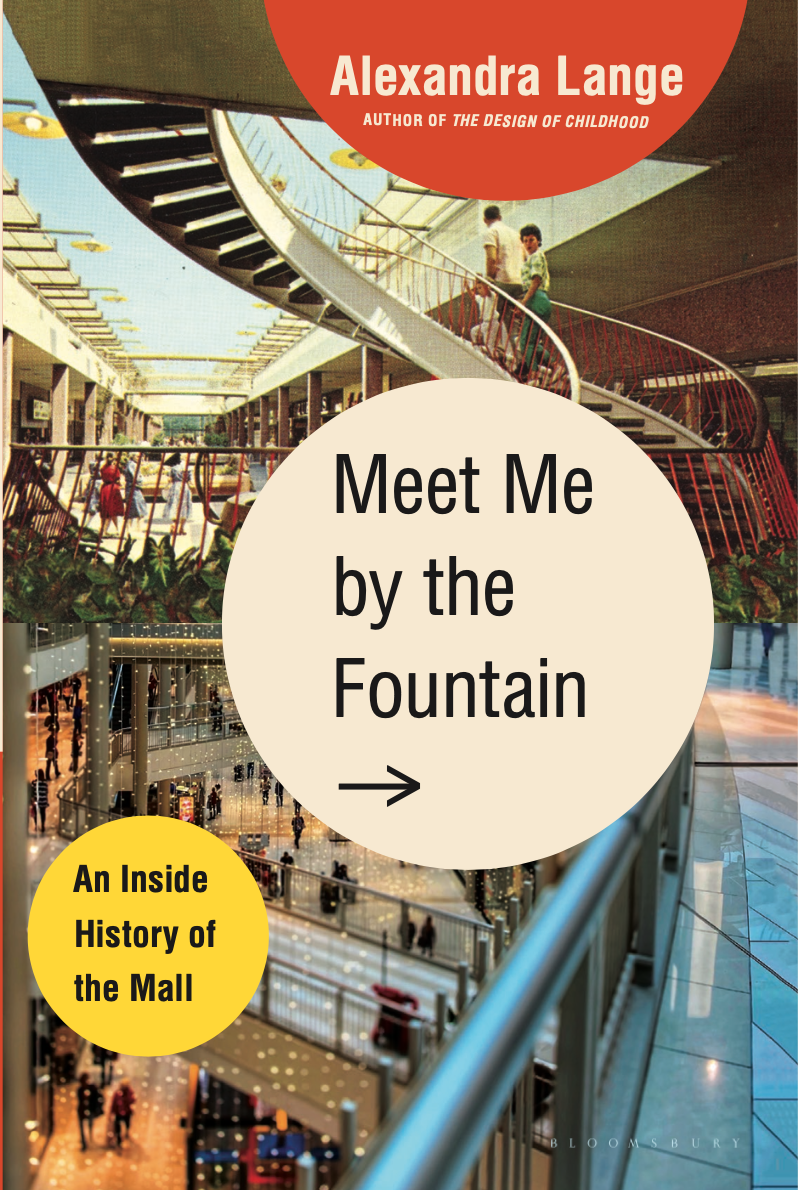
Alexandra Lange is a Pulitzer Prize-winning journalist, design critic, and author. Her writing has appeared in numerous design publications as well as in The Atlantic, New York Magazine, The New Yorker, and the New York Times. (This an edited-down list of just her writing accolades.) From her previous book The Design of Childhood: How the Material World Shapes Independent Kids to Making Do, her upcoming book about 1970s and do-it-yourself culture, there’s a clear throughline of Lange’s interest in the quotidian and domestic interactions people have with architecture and what that reveals about society.
Lange’s interest and expertise are especially clear in her most recently published work, Meet Me by the Fountain: An Inside History of the Mall. The book is a thorough critique, and tribute of the American mall as a structure, as a place, and as an idea. Covering roughly seven decades, Meet Me by the Fountain covers the institution’s ups and downs, through the lenses of architectural history, public policy, and pop culture.
Lange was kind enough to answer a few of my questions regarding her work. In the interview below, we cover Victor Gruen’s original conception of the mall, what goes into constructing long–form non-fiction, and, surprisingly, The Last of Us.
This book helped me further understand why ‘my mall’ (Roosevelt Field on Long Island) was built and operates the way it does—bringing elements of the city to the suburbs and how it feels like an island isolated from its surroundings. Did your research end up recontextualizing any past or contemporary experiences you have had with(in) malls?
I love to hear that! One of the aspects of writing about malls I struggled with initially was there were just so many—likely 1,500 in the U.S.A. at peak—so I worried that people would be disappointed that “their” mall didn’t appear. But so much of malls is actually cookie-cutter, that the context of one, or some, can help anyone to understand their own experience if they are willing to connect a few dots. Roosevelt Field is a good one, though—I.M. Pei doing Mies van der Rohe at the mall.
My big revelation came toward the latter part of the chronology, in trying to understand why some newer malls, like the Shops at Hudson Yards, did not work. Vertical urban malls are hugely popular, particularly in Asia, where most of the innovation in that type has occurred. But the New York version forgets about the importance of food, places to rest and people watch, and strong transit connections in making that type of mall great.
One of the recurring ideas that came up as we received submissions for this feature can be summed up as malls as a space for contradiction and juxtaposition. Some examples: work about shopping alongside work about working retail, or pieces about dead malls juxtaposed ones about thriving ones.
What I think your analysis in Meet Me by the Fountain elucidates is the current contradictory relationship the structure of the mall has with the people who frequent it. Malls sell products that are often inspired by youth culture, but are often hostile to actual teenagers, and though need people to thrive, those people can only have two modes of operation: shopping or working. Do you think this contradiction is inherent to the idea of the mall, or is the idea of the mall becoming more expansive?
I think contradictoriness is embedded in the idea of the mall. After all, Victor Gruen, the father of the shopping mall, was an Austrian Jewish emigre trying to bring the conviviality of Vienna cafe culture to Minnesota in the middle of winter. Contradictory! And he ultimately hated what malls had wrought, once they, and the suburbs, grew out of control, and went back to Europe!
The contradiction I struggled with was the way in which malls have become a stand-in for public, community space in places that have few alternatives, while being privately owned spaces that are designed to extract money from people from the moment they walk in. Contradictory! But I do believe the suburbs would be worse places without them, because Gruen did understand humans’ fundamental need to gather.
I was not surprised when certain elements of pop culture showed up. I expected to read about George Romero’s Dawn of the Dead and the mall-wave music genre. What surprised me were the times writers and their writing showed up. While I could count on Didion to provide California commentary, learning that Ray Bradbury inspired the Glendale Galleria was truly astounding. Is there a deeper connection between the mall and literature that most people are not aware of?
Those discoveries were fun for me, too! Too often we draw a hard line between what is ‘serious’ and what is light,’ and the latter often correlates to cultural products enjoyed by women and children. In both the childhood book and the mall book, I wanted to pursue the question, “What if this thing we thought was a sidebar is actually the most important?”
And then, as I began my research, I found many very smart people who has asked the same question in their time, like sculptor Isamu Noguchi designing playgrounds, or Ray Bradbury writing about (and engaging with the design of) malls. I don’t know that there is a deeper connection, but there is a strong connection, which comes from those visionary critics understanding the importance of shopping in the lives of late 20th century humans earlier than most.
In contemporary popular culture, I find it fascinating but unsurprising that one of the most emotional episodes of The Last of Us was set in a mall, with all the nostalgia for an un-shadowed childhood that setting could bring. That’s literary too, even if we are talking about a TV series based on a postapocalyptic video game.

This book covers a wide range of fields: architecture, public policy, and pop culture, just to name a few. How did those strands come together to form the overall ‘story’ of the book? Was the overall narrative something that you had to consciously work towards or was there an “A-ha!” moment that you were able to further expand upon?
My former editor at Bloomsbury, Ben Hyman, has very strong feelings about chronology in nonfiction, so I had decided from the beginning that each chapter of this book would cover a decade in mall history, starting with the 1950s and the acknowledged ‘first mall’ (Southdale, Edina, Minnesota, 1956). From an urban design and architecture point of view, innovation in malls starts to peter out in the 1980s, right as ‘the mall’ becomes a greater presence in pop culture. I felt there was a very natural rise and fall of innovation over time, and was able to use the decade by decade structure to focus on where the innovation was at that time.
I would also describe myself as a magpie– I follow a lot of different areas of culture, high and low—and I try to choose book topics that will let me indulge those interests while remaining on theme. Otherwise I would get bored—a character trait that is quite common among journalists.
When working on a long-form piece of researched-based historical analysis, you are obviously bound to the direction (or directions) that the facts present. Is there room for creative elements and self-expression in this type of writing? If so, how does it show up? Is it in the structuring, examples chosen, and/or choice of words?
Longform writing is governed by choices, most of which will be invisible to the reader. Where to begin the chronology? What to leave out? Who to leave out? Even which topic to pursue? I believe all of those choices are creative, and each of my books has been autobiographical in a way. The Design of Childhood isn’t possible if I didn’t have a baby. The mall book doesn’t make sense if I wasn’t a teenager in the 1980s. Further back, my first retail-related book, on the store Design Research, was about a famous modern design store both my mother and grandmother shopped at that shaped my taste from infancy.
I’m working on a new book now about the 1970s and do-it-yourself culture and that is inspired by a desire to explore values I absorbed as a child that seem very different from the way we approach stuff today.
What is an anecdote, a fact, or a specific mall that you found interesting that didn’t end up in the book?
When I’m asked to give a talk in a new city, I always try to look into their mall history to see if there’s an interesting one to add to the talk. I’ve given a couple of talks in Indiana, and in the research for one of them I discovered Keystone at the Crossing, a lost mall outside Indianapolis that was built in the 1970s to mimic the kind of organic retail redevelopment many cities were embarking on with former warehouses and factories, complete with a confusing layout, lots of local businesses, and a focus on handicraft. I’ll always love a good fake, and this seems like a good one. Shoutout to Tlaquepaque Village in Sedona, a similar idea with a very different (and geographically appropriate) aesthetic.

Alex J. Tunney (editor, he/him) is a writer somewhere in downstate New York. His writing has been published in the Lambda Literary Review, The Rumpus, Fauxmoir, First Person Scholar, Complete Sentence, The Billfold, The Under Review and The Inquisitive Eater. You can keep up with them on Instagram at @axelturner.

 Pine Hills Review