
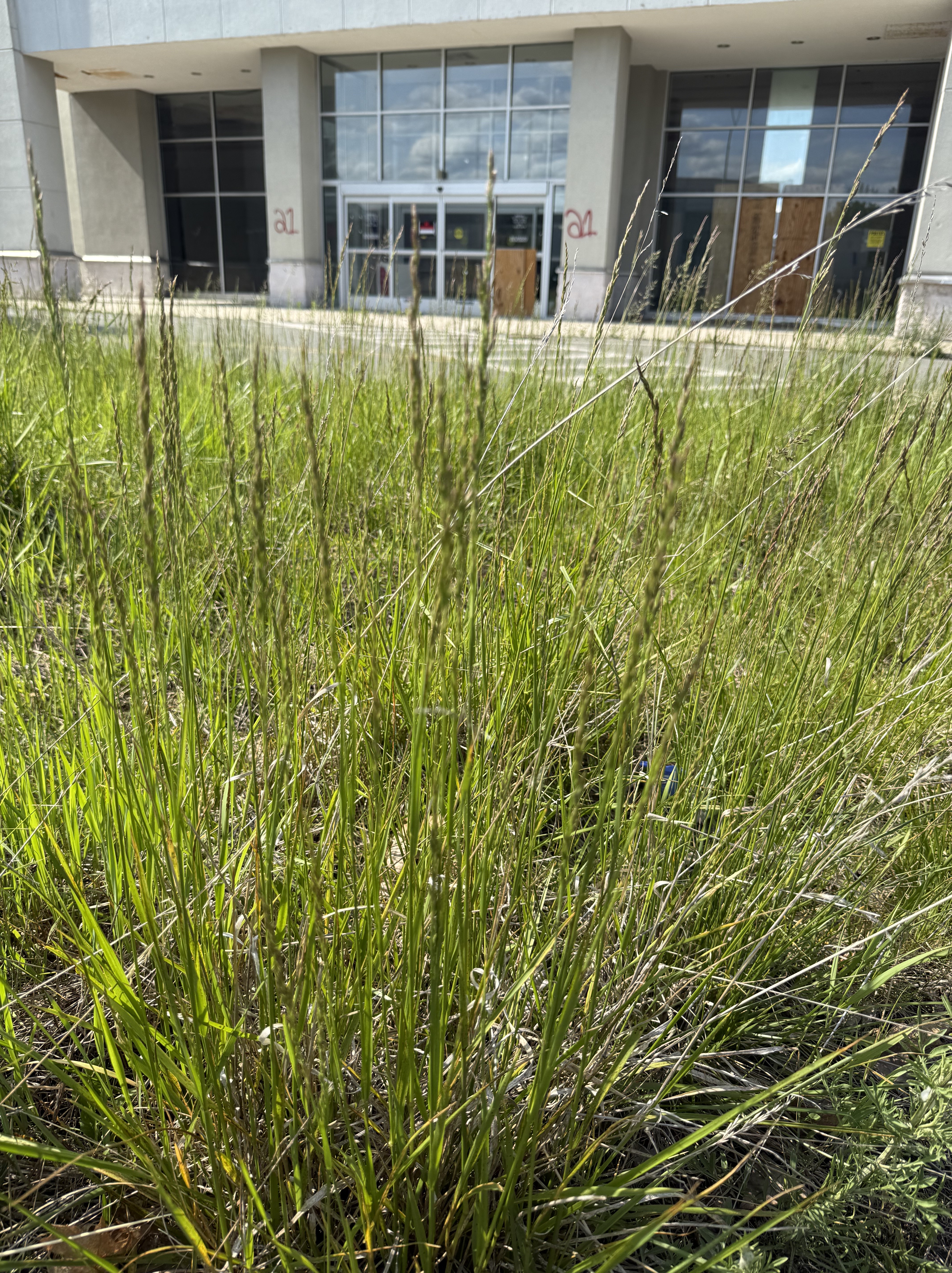
I am not what I once was. I was once a gathering place. Now, all my windows and doors are boarded up and numbered in red spray paint, dissected for the apprehension of trespassers. My signage has been removed and my parking lot is empty. It’s springtime and the sun still comes in through my skylights during the day, even though they’ve been left to darken with grime. Much of my furniture is sold—the cinema stripped of its seats, the food court of its tables and chairs. There are shopping carts and piles of old movie posters and pieces of mannequins abandoned in my halls. There are walls of graffiti and scatterings of BB pellets. There’s a room where all the holiday decorations are kept: The Christmas trees huddled in a corner with a pile of presents, the pastel gazebo where the Easter bunny used to sit. The smells remain in the stores, whiffs of cologne and leather. The trees planted in the mall’s floor that used to reach for the light have been chopped down, leaving a collection of narrow stumps.
△
The morning of my grand opening, the sun rose early and poured in through my skylights, through the doors, through the three glass pyramids that hung over my atriums. It shone on my polished tile floors and danced through the halls. It pierced all the shiny glass windows and refracted off the display cases. It tickled the leaves of the indoor trees. It was just me and the trees. I could feel their leaves blowing ever so softly in the ventilated air, mixing with the scent of floor polish and fresh paint, of unboxed merchandise, of the signature perfumes sprayed onto the mannequins the night before.
At 10 a.m., my doors opened for the very first time. There was a flag ceremony performed by a group of veterans and a trio played from a local music school. There were balloons and photographers and big banners. There were throngs of people—they said afterward over 30,000. The staff of the jewelry store wore tuxedos and cummerbunds, and the ice cream place handed out free cones. Buses of elderly people from nearby retirement homes came and sat in the food court. Middle-aged women mingled holding their jackets over crossed arms and chatting about the high school or layoffs at the General Electric plant. Their husbands bought burgers and hunkered down over tables. Families with small children raced around, trying to contain the kids hopping across the tiles and climbing over the shiny new benches. As you walked past the restaurants into the halls of stores, the smell of buttery baked pretzels and hazelnut coffee and fry oil mixed and gave way to vanilla body wash, and flowery perfume, and acetone.
△
I held a secret that opening day.
The mall developers, my creators, had moved fast. Too fast it turned out. They were called Pyramid Companies, and they had come to the area to buy and develop this land. Young white men in suits and slicked down, side parted hair. They talked about the bargain they had gotten—the land was cheap because large portions of it were wetlands protected from construction. Yet they had always planned to construct on them anyway. They joked that they were here to make another wonder of the world.
The secret was in my floors. Those who looked close enough on opening day would find the cracks, the tiles that had popped and split, that there had been no time to replace. My foundations were still floating in the wet earth beneath me. These men did not have the architectural ingenuity of ancient civilizations, they had a small budget and a spit-shined plan to move quickly whatever the consequences. I had tried to reach some kind of equilibrium, to rest myself evenly in the ground, but it had its own ambitions. This land was like a sponge, designed to absorb water every time it rained. And now that water floated beneath me, questioning my purpose. I knew my existence was more precarious than anyone admitted.
△
Even with the hasty construction, there had been a delay while they waited for my connector road. The road was the key to my project. I was required to have a route connecting me to the highway to alleviate the pressure on local streets. But it was the land on which the road would be built that required the most filling of wetlands and special permits. The Pyramid men started building me before they ever got these permits, trying to force the rest of the project through with promises of revenue and jobs. They knew this working-class city was recently drained of jobs and tax dollars by the gradual closure of the GE plant. They talked among themselves about how it shouldn’t be hard in this podunk to get the exemptions on these acres, but they hadn’t counted on the number of local environmentalists and small-town politicians who would still raise a fuss. Even when I was almost completely built, one especially ardent city councilor cried out for an investigation, citing construction workers who had come to him as inside sources, offering proof that this project was ill-fated.
For a time, the process stalled out. The Pyramid men seethed about how this was supposed to be a six-month job. They left the area and only came back every few weeks. They would show up early in the morning with motel coffees in hand and smiles plastered on their faces while they took calls and peered at blueprints. They paced my floors while they wheedled on the phone, their voices straining more on each visit, their wingtipped feet tapping out a rhythm of frustration on my floors. They had lines they used over and over: Without a mall, approximately 25 percent of the retail dollar was leaving the area. There would be “something for everyone,” a huge potential for community. And they spoke about stores that were “upscale” and “first quality.”
The day the bulldozers finally came, I could feel the reverberations in the earth. The soil gave easily, but the pitch changed, commotion in the water and above it, the scattered flapping of wings and calls echoing in the sky. The normal pattern of cries and twitters escalated for a short time, and then there was silence.
Once it began, it was quick—my road was built, and the vibrations of natural life around me were replaced by the arrival of the town. I could feel this new connection to the civilization outside me. I could feel the rumble in the concrete as processions of trucks and semi-trailers began to arrive. Now that the opening was approaching, company contractors from all over the country came to help finish the building, along with the flood of local people coming to interview for jobs. The future had been set out, and I felt the power of it flowing through me.
People would arrive before the sun came up and leave after midnight. I began to feel full. I had not considered my own vastness when there were just the occasional footsteps of the developers pattering through. Now I started to know the length of my hallways and the breadth of my stores as people busied themselves in every corner, behind every counter, in and out of every utility closet. I started to know what it meant to be a gathering place for a community I was yet to meet.
All day there was the sound of radios, drills, jackhammers. Workers were spread across every surface applying final coats of paint, fitting sprinklers and pipes, putting up drywall, cutting glass, installing light fixtures. In the food court, they lay giant pink and gray marble tiles. Employees were being hired at every hour of the day, new uniforms and keycards, laughter and handshakes. I had a 10-screen cinema, four big department stores, an arcade, and a food court. The managers talked about how there were more jobs than they could fill.
△
Now, in these spring months after my closing—a season when I should once again be filling with people—it’s instead very quiet. I miss the teenagers most of all. In my first days, young people thronged. Gangly youths with long hair and acne who smelled like marijuana and fruity body products. They brought a kind of wild energy. They jumped and shouted as they throttled joysticks in the arcade. I could feel their pounding on my marble floors, and their laughs echoing through the corridors. They gossiped over manicures, and flipped through racks of bikinis in their jackets, and shoplifted bras under their sweatshirts at the lingerie store. They visited the teen outfitters to giggle and push each other around over the lanky boys or big-eyed girls that worked there. Then they would visit their friends working at the record store or bookstore, draping their bodies over the checkout counter and nervously playing with each other’s fingers. Flipping through the CDs and magazines. They skipped through the halls and got giant popcorns at the cinema and spilled it all upon sitting down. They worshipped the graphic tees and jean jackets and sneakers in my stores. They picked up cable knit sweaters and white cowboy boots and stonewashed denim, exclaiming, “Oh, this is so cute!”
Now, despite the boarded-up doors, the security, the police patrol, the teenagers still come back. Even though I’m filled with water damage and asbestos and mold. They talk about how they miss me—even though these kids were only small children when they would visit. They still exclaim over what they find within me—old menus, little plastic toys, the sign for my hot dog stand. There’s one wall in what used to be a large department store where they like to spray graffiti. They film around the old cinema, exclaiming about how creepy it is. They like to strut down my hallways and do synchronized dances. I don’t mind, it’s nice to have them there.
△
I knew the years of abundance couldn’t last—all the Black Friday crowds, and spring jamborees, and midnight blockbuster releases could only be temporary. My road, my crucial connector, the topic of so much conflict, would never hold. Shortly after it opened, several areas heaved and collapsed. A few years later, more chunks crumbled. When they tried digging it up and repaving it, the clay mushroomed out of the asphalt almost immediately. The workers said they had never seen such a thing. There were constant reports of the road flooding, dipping, and breaking up.
They’ve had plans to knock me down, they talk about building a senior center. Even in all my disrepair, I don’t want to be demolished, taken out in such an immediate manner. I’ve grown attached to this piece of land. Eventually I will fall, as the earth below me swells and transforms and my foundations slowly deteriorate. But I like this time, as bits of earth and plants are coming up through the cracks in my floors. As the trees and bushes around me have grown up past my windows, and deer and bears amble around me.
△
Before me, there were wetlands. They hummed day and night. I became aware of everything around me as I was built. There were ducks, geese, wading birds, songbirds, frogs, beavers, dragonflies, bass. There was the Barren strawberry, with its yellow flowers and tiny fruits. The scrubby little horsetails. The low twitters mixed with high whistles of birds. Clusters of swaying pondweed. It felt almost like you could feel the sun coursing into it all, filling it up, pushing through the plants to feed the fish to feed the birds.
Before I opened, I just listened to the land around me. The earth was soft, wet, malleable, it burbled and shifted and was full of life. For a long time, we sat together. I was new to the landscape. I felt myself take place.

Cleo Levin is an M.F.A. candidate in nonfiction at The New School. Her writing has been supported by The New School, the Southampton Writers Conference, and Barnard College. She previously worked as an editor at Slate. Her work has been published in Slate, The Daily Beast, and The WILD Magazine.
Image: “Encroachment” by Eric Weinstein

 Pine Hills Review