
Mom and I shopped for perfume every weekend to satiate my desire to collect exotic extracts of Turkish rose, oud, and violets. After our spritzing sessions, we swizzled sticks in decadent yuzu martinis in the outdoor food court. That was before the relapse into a disorder whose severity we never would have predicted.
Door handles to the mall’s stores filmed over, cloaked themselves in a sludge that lingered longer on my palms than in my 20’s. Mom helped me into stores by holding the doors open. We pre-meditated skits in the car for how she could race to the door before me, to hide my embarrassment of having a spry senior with a gray pixie cut open the door for an able-bodied brunette. When I accidentally dropped an empty lipstick and stalled to pick it up from the sidewalk, she would deviate from the plan and stop walking, despite our rehearsal. I’d shout under my tongue, “Mother! Keep walking. Don’t make me look like an asshole!” We were the epitome of Lucy and Ethel.
Then, the death knell. Inside the doors, my favorite things—bottles full of oily liquid—started to breed germ colonies, too, under warm counter lights that drew fingerprints up through smudges. I couldn’t touch them anymore, no matter how shapely the glass, how pastel their pink, how froufrou their tassels.
Mom would lift the elegant vessels and spray me down with sandalwood, mandarin, whatever matched the seasons. When something piqued my interest, I’d mumble the name, bobble my neck sideways, widen my eyes, and bore lasers into the bottle in question. She seldom deciphered the signals, so we’d hide around an end cap, where I’d whisper-shout the name, “Duh-lee-nuh!”
“Nuh-lee-duh?”
“No! Duh-leeee-nuh!”
They’d hand it to her and she would spray the strips of paper, and on my nod, she’d spray my tee shirt. If I bought something, she would swipe my card and sign as though she were me. We would smize at each other; it was our secret. Sometimes salespeople would offer a choice of samples, and she’d ask me what would go best with “her” chemistry. She was a No. 5 gal, so I’d get her a bottle for her trouble, and tell her what samples would suit her, of course.
That worked until the severity peaked and germ colonies became armies: took the shape of people around me who always seemed to sniffle and cough.
“Probably just allergies to the perfume,” she’d say.
“Mom, it’s February. They obviously have the flu! Don’t you smell the cough drops?”
“Whatever you say, babay.”
“We gotta go, I’m starting to hyperventilate.”
A day came when I watched Mom through the windshield of the car where a fantasy force-field shielded me from germs while she stood outside the store holding the door open, its shadow cast on concrete. She capitulated and returned to the car, eyes puffing out.
It was the end of a season, and the start of a winter that lasted years. Red Baccarat crystal became kitchen sink windowpanes where I spent a lot of time washing. Mom came to visit on the weekends and brought frozen yuzu, but homemade martinis tasted metallic. Our conversations centered around news, shows and politics, since I was home-bound. She didn’t enjoy going places alone, so I’d ship her beloved seasonal Chanel No. 5 like liquid guilt.
When Mom’s sight declined with age, and she could no longer drive, we were both tethered to our respective sofas four miles apart. We FaceTimed, discussed more politics and how much she missed me. She could never find the X on the screen to disconnect, and I pretended not to know either, so she could hang up first. Each time, I’d pummel the memory foam mattress for not being able to just leave the goddamn house to see her, for defeating myself, for scrubbing invisible lies off my skin that never washed clean.
In some rational part of my mind, each weekend, I slide the snow clouds behind and flip the convertible top back. At her favorite Chinese restaurant, I scrawl my own signature with the plastic pen on a rope and carry bags by the handles. At the grocery store, my cart wheels past some guy who sniffles in the citrus aisle. On a drive over to Mom’s, sunlight activates my dormant melanin. After I touch the elevator button, rise to the 5th floor of independent living, and chat with the people onboard, Mom tugs the door open. She says she’s been waiting, she knew I could do it, and how proud she is. That’s how it goes in my mind’s eye, but I can’t see past the snow’s glare, and I’m terrified it won’t melt in time.

Crystal Taylor is a writer and poet from Texas. She works to break the stigma associated with neurodivergence. Her nonfiction pieces live in Dorothy Parker’s Ashes, Gargoyle Magazine, Roi Finéant Press, and other sacred spaces. Engage with her on Bluesky @CrystalTaylorSA, and Instagram @cj_taylor_writes.
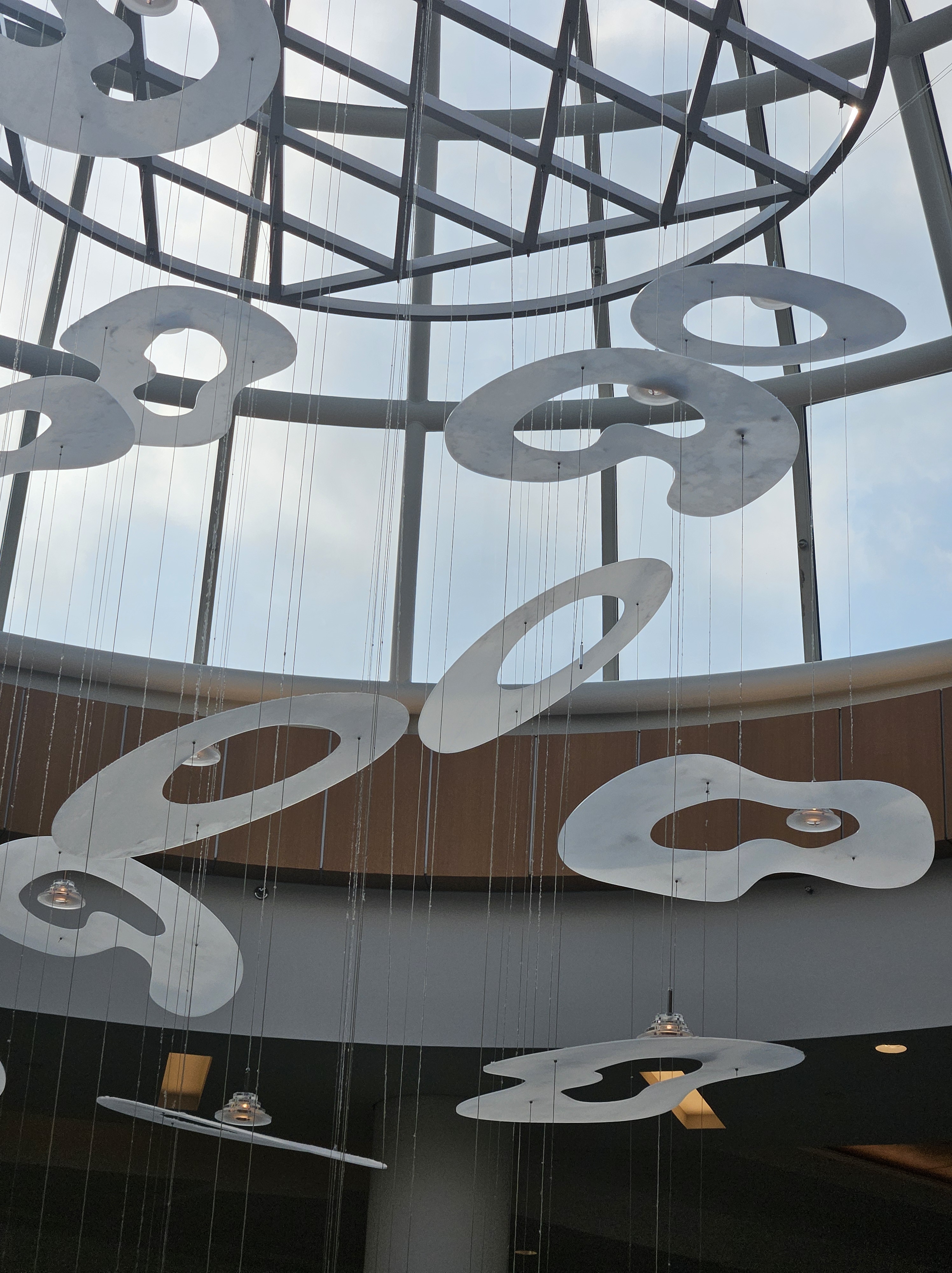
Image: “Floaters” by Alex J. Tunney
 Pine Hills Review