Going to the Hudson Valley Mall with my parents and two siblings was a common family outing growing up. Living in the middle of the country, it was the closest mall to us, and often the focal point of local entertainment. Wrangling me and my two siblings into a car was no easy feat for my parents, yet they managed to do it nearly every weekend. We would sit in the back seat, our carseats pressed side by side, and my dad would blast oldies music on the radio. The ride was just about 40 minutes, which seemed longer when I was younger. We would park outside of JCPenney and walk through store after store, always ending in the food court area. The landscape of that mall would change so much over the years, just as we did. Stores changed, food spots came and went, and we continued to grow.
The mall of my teenagedom no longer reflects what is there now. The stores that used to fill the vast tiled corridors were replaced with walls to block out empty caverns where stores once stood. Today, the Hudson Valley Mall is mostly composed of different medical pavilions and a space where the elderly go to get their daily steps in. Few stores remain, but the residual nostalgia of what the mall once was lingers heavily in my heart.
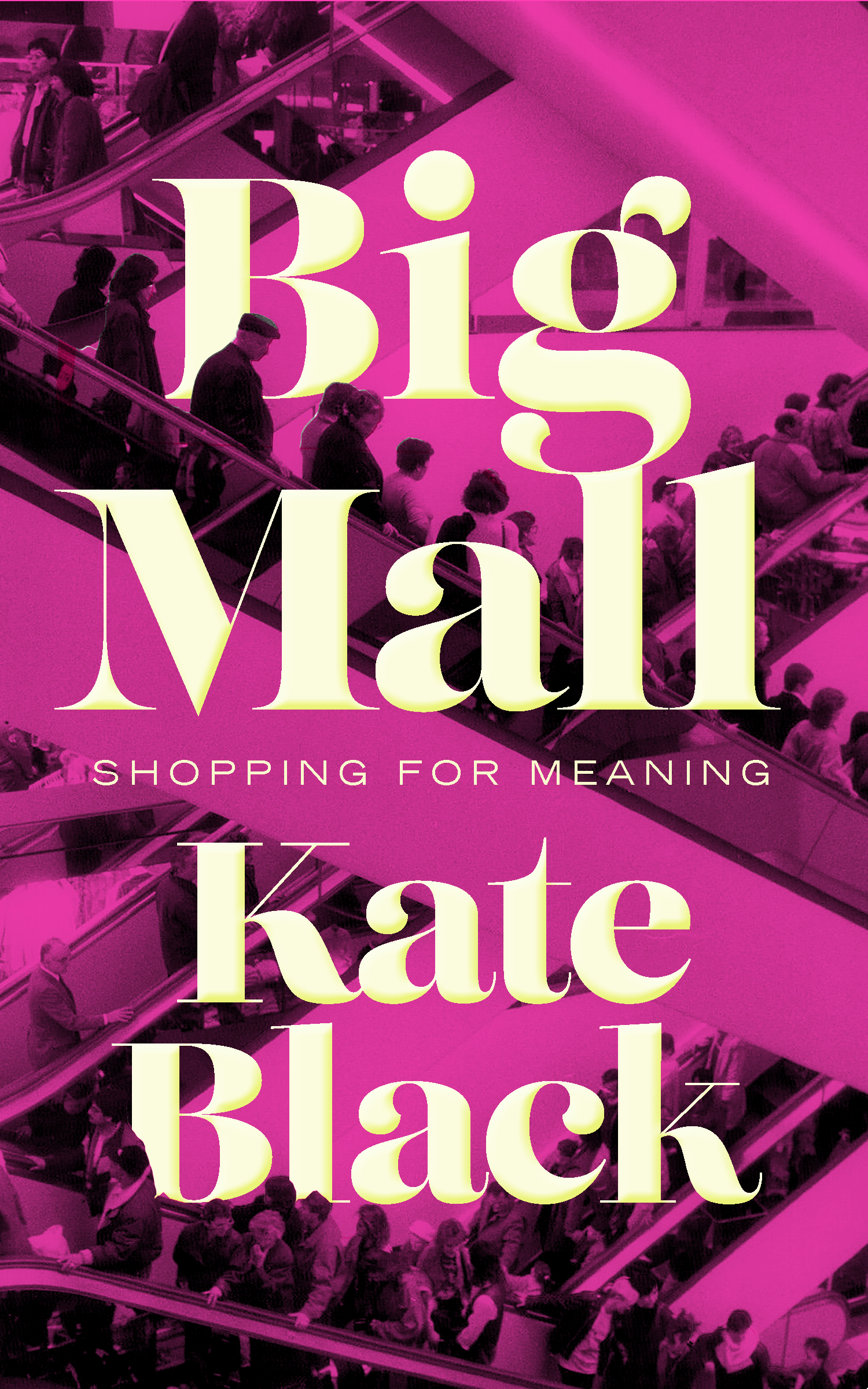
Kate Black’s Big Mall: Shopping for Meaning examines a similar lingering nostalgia, the development of malls into the modern era, consumerism, animals in malls, teenagedom, and her own experience coming to age just a stone’s throw away from North America’s largest shopping mall, West Edmonton Mall.
Kate Black is a multi-genre writer who has an M.F.A. in Creative Writing from the University of British Columbia. Black’s essays have been published in The Globe and Mail, The Puritan, The Walrus, and other publications. Black is a prolific writer who has won a National Magazine Award and was also chosen as one of Canada’s top emerging voices in nonfiction by the RBC Taylor prize in 2020.
In this interview, Kate Black and I discuss all things related to the mall—from pop culture, capitalism, the shift to online shopping, to mall rats, true crime, and animals in the mall, we truly dive deep into all things “Big Mall.”
My favorite question to ask each writer that I interview is: where are you physically, emotionally, mentally? Are you somewhere among the clutter of people within the nostalgic landscape of a mall that once was what you no longer recognize it to be?
I’m doing well! I work as a high school teacher, which means I’m currently on summer break. I’m somehow still keeping quite busy with freelance writing work and enjoying the amazing weather we’ve been having in Vancouver over the past couple months.
Not too sure how to answer the second part of this question, but I must say that I’m enjoying my time outside too much to be too nostalgic for the mall at the present moment, haha.
One of my initial questions before reading your book was, why write a book about malls? What led you to do this? Was this a project you had planned out, or was it something more than that?
I grew up in Edmonton, AB, which is home to West Edmonton Mall—North America’s largest (and formerly the world’s largest) shopping mall. I didn’t realize that this was a particularly unique life experience until I moved to Vancouver. Most people, as it turns out, don’t grow up in the shadows of such a gigantic cathedral of consumption.
I started getting curious about what impact the mall has had on me: the one in Edmonton, specifically, but also how the spectre of the mall seems to follow us everywhere in late-stage capitalism. I felt like a book was the best way to explore these questions.
In Big Mall, you discuss malls in various ways in connection to pop culture, societal views, art, concepts of psychology, and both virtual and personal experience. So, tell me, what is a mall to you? What were your go-to stores and food kiosks? What did a day in the life of a teenage you look like going to the mall?
In the book, I describe the mall as an ‘altar of becoming’—a place of total possibility. I felt, and honestly still feel, exhilarated by how buying something new has the potential to transform myself. (Whether this potential ever actually realizes itself is another question.)
As a teenager, I was big into Forever 21 and Urban Outfitters and aspirationally browsing the sales racks at Hollister and Abercrombie. West Edmonton Mall is also quite unique in the sense that it also features a giant waterpark and rollercoaster, where we would often go for friends’ birthday parties and rewards from our school for getting good grades. When I think about growing up in the mall, those aspects feature just as prominently as the shopping.
You also talk about malls, capitalism, and convenience. Since the beginning of the 21st century, there has been a shift from solely shopping in person to an increase in online shopping. With fast fashion on the rise, do you believe that there will be a time when malls and their original intention will become obsolete?
I don’t think large malls like West Edmonton Mall will become obsolete anytime in the near future; they’re constantly evolving to meet the needs of their clientele. In most successful large malls, this means featuring things aside from shopping, like I mentioned above, to draw people in. With the decline of big box stores like Macy’s and Nordstroms (and The Bay in Canada), this is more important than ever.
I don’t think this is contrary to the original intention of malls; in fact, it’s even more in line with what Victor Gruen, the architect of malls, wanted in the 1950s. He wanted malls to breathe life into the suburbs and envisioned the shopping aspect of malls as just one part of this. He thought malls could be a place where you walk around, look at art, have coffee with a friend, or even drop your kids off at daycare and go to a doctor’s appointment.
What do you believe is lost with the experience of shopping online versus shopping in person? Or what is gained?
When we shop online, I think we gain convenience but lose our physical relationship with the things we buy. We don’t know what they look or feel like until we’ve already handed over our money.
On a deeper level, I think we miss out on the social aspect of shopping: talking to the sales associate, people-watching in the food court. I can imagine that if you work from home and don’t take public transit in a city like Edmonton, going to the mall is one of the few times you’re visibly aware of the fact that you live in a society.
You mention the concept of a place vs. a nonplace in the first section of your book titled “Space.” What do you define as a place and a nonplace? Where does the mall fall in here? Can we be in a place and a nonplace at the same time?
The mall can definitely be a place and a non-place at the same time. On one hand, the mall is a non-place because, like an airport or a highway, it’s largely designed to have us pass through and not stay too long if we’re not being productive. We can get kicked out for loitering. But what about the people who work in the mall? Or teenagers who make core memories there? In some ways, these people are stepping outside of the purpose of the mall, which is to buy things, but are certainly making their own “place” out of it.
Reading the second section entitled “Youth,” I couldn’t help but keep singing to myself the lyrics of My Chemical Romance’s “Teenagers,” which you mention. Through the development of the concept of teenagers post-WWII, we were granted not only new clothing lines, new magazines focused on teen girls, a new era of pre-adulthood that once never existed before, but a new target group of consumers.
What do you imagine consumerism, especially in malls with so many shops targeted to youth, to look like if this movement never occurred?
It’s hard to imagine one without the other. I think the rise of consumerism in the 1950s made both malls and teenagers as we know them today possible. As much as people like to complain about mall rats, we wouldn’t have malls without them.
Your inclusion of the relationship of teenagers and their self-found home within the mall, their integration into society, and your explanation and exploration of mall rats intrigued me. Do you find that the invention of teenagers led to the exploitation of people of an easily manipulated and swayed group? Do you believe that the focus on this age group is what led to their deviance in these public spaces? Or do you believe that it is the lack of supervision?
I don’t think consumerism’s construction of teenagers necessarily caused them to rebel against the rules of the mall, but it certainly makes it seem more ironic when people clutch their pearls about teenagers’ behavior in malls.
I think that acts like loitering and shoplifting are ways of seeking agency in a space, and an age, where our actions are highly surveilled. It’s kind of like talking back to the consumerist symbol that created you.
Many times, especially in section of “Youth,” I found myself relating to your personal anecdotes. Your inability to be a mall rat in your youth, despite your desire to be one. The desire to be more than what you were at that time and to continue to invent and reinvent yourself.
How do you think your experience of malls in your youth differed from the experience of others your age at that time?
Quite closely to what you describe here! I never felt cool enough or like I had enough money to buy exactly what I wanted—and become exactly who I wanted to be. I realize now that even if I had a million dollars at 16 years old to blow at the mall, it somehow wouldn’t feel enough. Even though I felt like an outsider at the time, I think this is actually how many teenagers felt and still feel at the mall. It always keeps us wanting more.
You touch on so many important yet controversial topics that are running through the world currently: racism, differences in publicization of true crime cases between white and BIPOC victims, missing indigenous women, the political climate in the United States post the 2016 election, COVID, and the global warming crisis. As a writer, what do you think about using your craft as a source of information and education? Do you think that it is the job of the writer, to inform and educate?
I don’t actually think it’s all writers’ jobs to do this, and I don’t think I set out to do that, either. (Which is weird to write down, as a teacher!)
When I write nonfiction, I’m mostly seeking to educate myself. I ask questions and then set out to answer them. I thought it was impossible to tell the story of malls without touching on how systems of oppression manifest themselves there. And although it isn’t my preeminent goal, I think it’s cool that people could think critically about those topics while reading a book about malls—it’s kind of like hiding the vegetables.
I never realized how closely integrated animals, especially ones we see in zoos, are with mall systems. Perhaps it’s because I’ve only seen cats, dogs, tarantulas, birds, and lizards in pet stores in malls. To imagine a gorilla, sea life, or anything else in a mall is crazy to me. I guess it is expected in cases such as Ivan, the gorilla you talk about, that the mall wouldn’t want to lose the income that comes with this. What was your purpose for the inclusion of these animal stories? How do you feel about animals being in malls?
It’s crazy to me too! I grew up watching the dolphins at West Edmonton Mall, which have since been replaced with sea lions. Again, I didn’t realize this was strange until I grew up and learned that most other malls don’t have formerly wild animals performing in them. I wanted to use that chapter in the book to make sense of these anomalies: why have animals found themselves in malls? What does that teach us about humans’ relationship to animals?
At the end of this book, I find myself with a few more questions. Where do you think we would be without money? What would society be? Do you think that the world would be better without capitalism?
Huge question! I feel like I can only echo the phrase that many other writers have offered before me: it’s easier to imagine the end of the world than the end of capitalism.
It’s baffling to imagine how much of our consciousness is impacted by the logic of capitalism. Like, war has been fought and people have died to uphold capitalism. It’s hard to imagine a way out. Nevertheless, I think it’s important to dream and talk about the kind of world we want to live in. How can we make people’s lives more dignified despite the amount of capital they produce?
I don’t necessarily know if the world would be better without capitalism carte blanche. I do know that the world would be better without the human suffering that is happening alongside astronomical disparities of wealth.
OK, last question. Do you have other projects that you are working on that you would like to tell me about? Any new books,essay collections, etc? Where do you find yourself in your writing process right now?
I’m actually not working on any of my own writing projects right now and it feels pretty nice. I find teaching to be quite creatively fulfilling and am still learning to enjoy my time without giving myself the perpetual homework assignment of writing a book. Stay tuned!

Samantha Zimmerman is an editor of Pine Hills Review and is an all-over-the-place poet with a passion for all things experimental and confessional. Her work has been featured in Sledgehammer Lit, Bullshit Lit, Discretionary Love Magazine, BarBar Lit, and The Afterpast Review. You can keep up with her on Twitter @samthezim.
 Pine Hills Review